
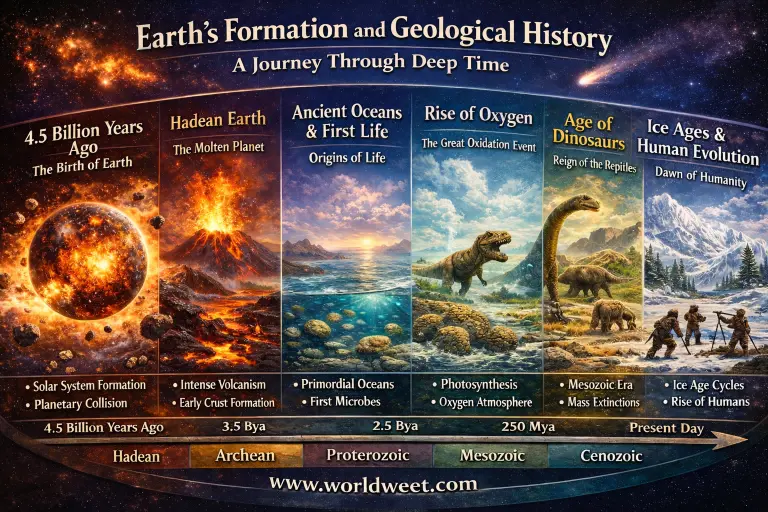
Earth is approximately 4.54 billion years old, yet modern humans have existed for only a tiny fraction of that time. Over billions of years, our planet has transformed from a molten, lifeless sphere into a world filled with oceans, continents, complex ecosystems, and intelligent life. To understand this immense story, scientists divide Earth’s past into geological time periods, each representing a major stage in planetary evolution.
This article offers a clear of Earth’s formation and history, written for general readers who want to understand how our planet became what it is today.
The Birth of Earth – How It All Began
Earth formed about 4.54 billion years ago from a rotating cloud of gas and dust left over after the birth of the Sun. Through gravity, particles collided, stuck together, and gradually formed larger bodies called planetesimals. Over millions of years, these bodies merged to create the early Earth.
At this stage, Earth was extremely hot. Constant asteroid impacts and internal radioactive heat kept the surface molten. Heavy elements like iron sank toward the center, forming Earth’s core, while lighter materials rose to form the mantle and crust. This early differentiation laid the foundation for Earth’s layered structure.
Hadean Eon – A Hellish Young Planet
(4.54 – 4.0 billion years ago)
The Hadean Eon marks Earth’s earliest phase. Conditions were harsh and unstable:
- The surface was largely molten lava
- Massive asteroid bombardments were common
- The atmosphere was toxic, dominated by carbon dioxide, methane, and ammonia
- There was no free oxygen and no life
Despite these extreme conditions, scientists believe the first oceans may have begun forming toward the end of the Hadean as Earth cooled and water vapor condensed. This set the stage for the next major chapter in Earth’s history.
Archean Eon – The First Life Emerges
(4.0 – 2.5 billion years ago)
During the Archean Eon, Earth cooled enough for stable oceans and early continents to form. This period is especially important because it marks the origin of life.
The earliest life forms were simple, single-celled organisms, similar to modern bacteria. Many lived in the oceans and did not require oxygen. Among them were cyanobacteria, which used photosynthesis to produce energy — and released oxygen as a byproduct.
Although oxygen levels remained low, these early organisms quietly began changing Earth’s atmosphere forever.
Proterozoic Eon – Oxygen and Complex Life
(2.5 billion – 541 million years ago)
The Proterozoic Eon represents one of the most dramatic turning points in Earth’s history.
As photosynthetic organisms multiplied, oxygen slowly accumulated in the atmosphere during an event known as the Great Oxidation Event. While toxic to many early life forms, oxygen made it possible for more complex organisms to evolve.
Key developments during this eon include:
- Formation of a stable oxygen-rich atmosphere
- Evolution of multicellular life
- Development of early ecosystems
This eon also witnessed several global ice ages, including the Cryogenian Ice Age, when Earth may have been almost completely frozen — a concept known as “Snowball Earth.”
Phanerozoic Eon – Life Becomes Visible
(541 million years ago – present)
The Phanerozoic Eon is defined by the rapid diversification of complex life forms. Fossils from this eon are abundant, making it easier for scientists to study.
The Phanerozoic is divided into three major eras: Paleozoic, Mesozoic, and Cenozoic.
Paleozoic Era – Life Conquers the Land
(541 – 252 million years ago)
The Paleozoic Era saw life expand dramatically in both the oceans and on land.
- Marine life flourished with fish, corals, and shell-bearing organisms
- Plants began colonizing land, followed by insects
- Amphibians and early reptiles evolved
- Vast forests altered Earth’s atmosphere and climate
This era ended with the largest mass extinction in Earth’s history, wiping out around 90% of marine species.
Mesozoic Era – The Age of Dinosaurs
(252 – 66 million years ago)
Often called the Age of Dinosaurs, the Mesozoic Era was dominated by reptiles.
- Dinosaurs ruled land ecosystems
- The first birds evolved from small dinosaurs
- Early mammals appeared but remained small
- Earth’s climate was generally warm
The Mesozoic ended abruptly when a massive asteroid struck Earth, triggering global climate disruption and the extinction of non-avian dinosaurs.
Cenozoic Era – Mammals and Humans
(66 million years ago – present)
The Cenozoic Era is the era we live in today.
- Mammals diversified and became dominant
- Grasslands spread across continents
- Major mountain ranges such as the Himalayas formed
- Earth’s climate gradually cooled
During this era, repeated ice ages shaped landscapes and influenced evolution. Modern humans (Homo sapiens) appeared roughly 300,000 years ago, making us newcomers in Earth’s long history.
Ice Ages – Cycles of Cold and Warmth
Ice ages are long periods when global temperatures drop and ice sheets expand across continents. They have occurred multiple times throughout Earth’s history.
The current Quaternary Ice Age began about 2.58 million years ago. Although glaciers exist today, we are living in a warmer interglacial phase.
These climate cycles have played a crucial role in shaping Earth’s surface and guiding the evolution of life.
Why Earth’s History Matters Today
Understanding Earth’s geological history helps us see climate change, biodiversity loss, and environmental shifts in a broader context. While Earth has survived dramatic changes before, the speed of modern human-driven change is unprecedented.
By learning how Earth evolved over billions of years, we gain insight into our responsibility to protect the planet’s future.
From a fiery beginning to a world rich in life, Earth’s story is one of constant transformation. Each geological period contributed to the planet we call home today. Studying this history reminds us that while Earth is resilient, its balance is delicate — and our role in shaping its future is greater than ever.