
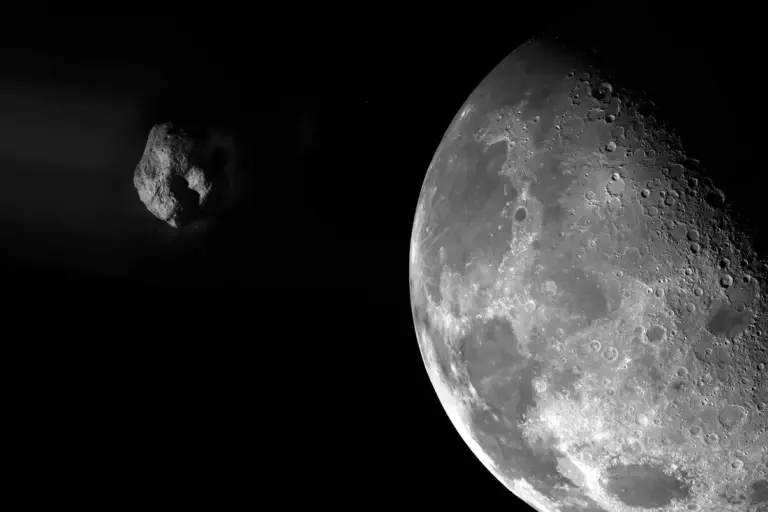
A new study involving NASA scientists and international experts is fueling debate: should humanity try to destroy an asteroid that could collide with the Moon in 2032—or leave it alone?
The object in question is large enough to be labeled a “city killer” if it ever struck Earth. While a direct Earth impact has been ruled out, researchers say a Moon strike could still create serious risks for astronauts and satellites.
The Space Impact Risk
The asteroid, 2024 YR4, was first detected in December last year by the ATLAS asteroid impact alert system in Chile.
NASA estimates it could be up to 220 feet (about 67 meters) across—big enough to cause devastating damage if it hit a populated area on Earth.
Early assessments suggested around a 3% chance of a direct Earth impact, but updated orbital analysis has eliminated that scenario.
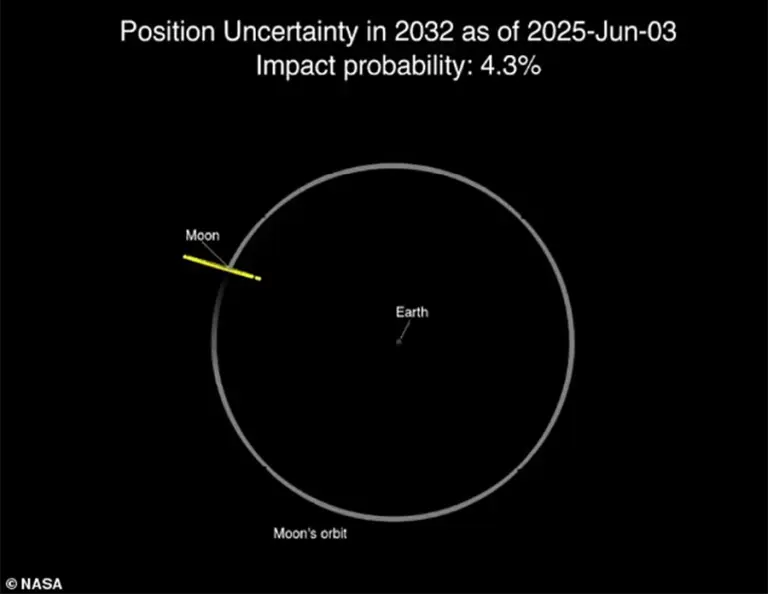
However, the threat has shifted: current calculations indicate about a 4.3% probability that 2024 YR4 could strike the Moon in December 2032.
Researchers warn that if it hits, the blast could eject debris at more than 1,000 times the usual level. For several days, that debris could endanger astronauts and satellites in low Earth orbit, raising a difficult question:
Do we intervene—or let the impact happen?
Option 1: Nuclear Interception Before Moon Impact
One proposal in the study is using a nuclear device to break up 2024 YR4 before it reaches the Moon. Scientists describe this as a high-force approach—aiming to fully fragment the asteroid.
But the risks are substantial:
- A real nuclear test to destroy an asteroid has never been conducted in space
- The asteroid’s true mass is still uncertain
- A miscalculation could create a worse debris field than a single impact would
“If the explosion isn’t powerful enough, you may just create a massive cloud of dangerous fragments,” warned Julie Brisset, acting director of the Florida Space Institute.
Option 2: Deflect the Asteroid Instead of Destroying It
A less extreme alternative is trajectory deflection—nudging the asteroid off course.
NASA demonstrated this concept in 2022 with the DART mission, deliberately crashing a spacecraft into the asteroid Dimorphos and measurably altering its orbit. The key takeaway: humans can change an object’s path without blowing it apart.
But applying the same method to 2024 YR4 depends on one critical factor: accurate mass measurements. Without that, planners can’t reliably calculate how much force is needed to shift its orbit.
Speaking to NBC News, Kelly Fast, acting head of NASA’s planetary defense office, said the agency currently has no plan to intercept 2024 YR4.
Instead, NASA intends to observe it using the James Webb Space Telescope early next year. With better data, scientists may be able to refine the Moon-impact probability—potentially even driving it down to 0%.
The Geopolitical Problem Nobody Can Ignore
Even if the technology exists, intervention introduces political and legal complications.
- China aims to send astronauts to the Moon by 2030 and has mentioned the possibility of building a nuclear power facility on the lunar surface.
- The U.S. is also planning regular lunar missions throughout the next decade.
A nuclear action in space—especially near the Moon—could escalate tensions. It raises hard questions:
- Which country would be accountable?
- Who has the authority to deploy a nuclear device beyond Earth?
- Would capable nations actually cooperate?
“Only three or four countries likely have the technical capacity to do this,” Brisset noted. “But whether they would collaborate is a different matter.”
Why a Moon Impact Still Matters to Earth
Even if 2024 YR4 never hits the Moon, the discussion highlights a growing reality: planetary defense isn’t only about protecting Earth’s surface.
A major collision on the Moon could disrupt the space environment around Earth, threaten crewed missions, and put critical satellite infrastructure at risk.
In short: a lunar impact could become an Earth problem—fast.