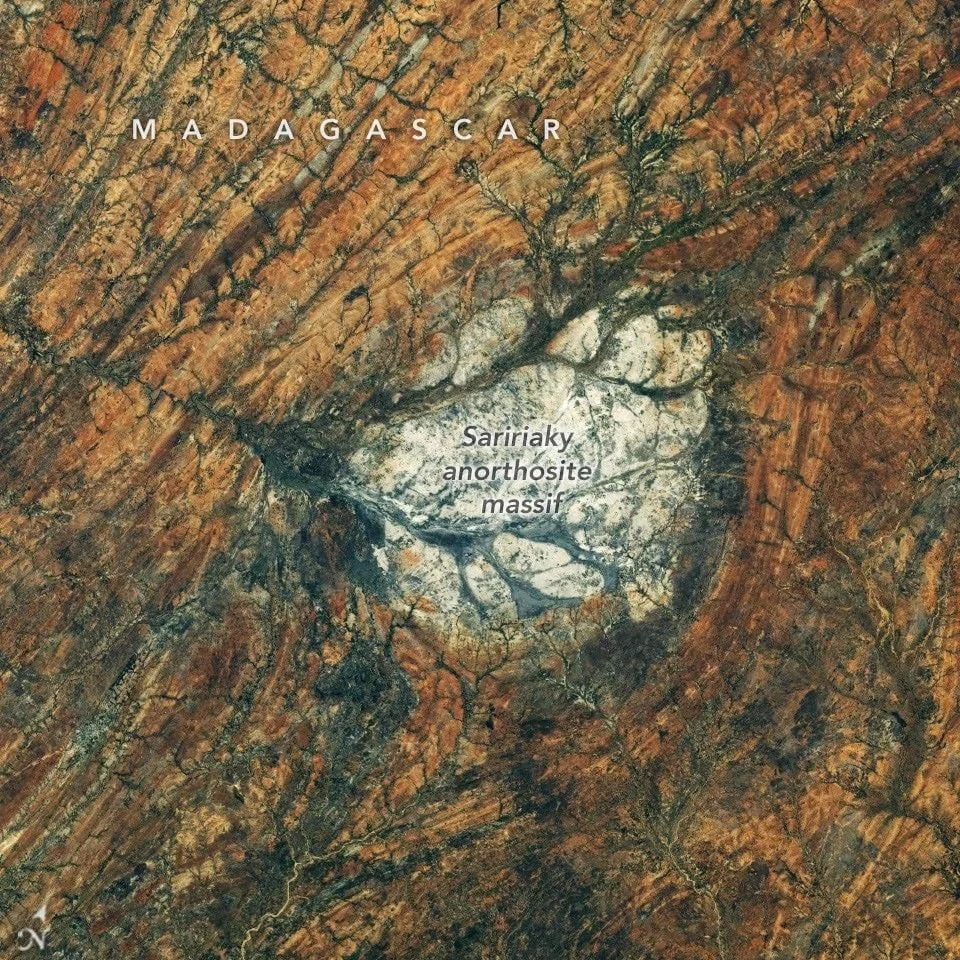
High above the Mozambique Channel, an astronaut aboard the International Space Station (ISS) peered down at the arid terrain of southwestern Madagascar and photographed a striking geological oddity: a colossal, gleaming formation of pale rock standing in sharp contrast against the surrounding reddish-brown topography. Known geologically as the Saririaka massif, this ancient rock complex holds deep scientific significance because it consists almost entirely of anorthosite—the exact igneous rock that constitutes the bright, cratered highlands of the Moon.
Formed at least 600 million years ago deep within Earth’s lower crust during the assembly of the ancient supercontinent Gondwana, this immense terrestrial anorthosite exposure offers planetary scientists a rare natural analogue for decoding the primordial crustal evolution of both Earth and the Moon more than 4.4 billion years ago.
The Lunar Connection: Why Anorthosite Is Rare on Earth
On the Moon, anorthosite is ubiquitous. Planetary geologists know that during the formation of the lunar magma ocean shortly after the Moon coalesced from the debris of a giant impact, plagioclase feldspar crystals crystallized and floated upward like icebergs because they were less dense than the underlying mafic magma. This produced an almost pure anorthosite flotation crust, forming the pale lunar highlands that human eyes see shining in the night sky.
On Earth, however, anorthosite is extraordinarily rare. Terrestrial plate tectonics, continuous volcanism, atmospheric weathering, and water-driven mantle convection constantly recycle and alter rocks. Finding a pristine, massive intrusive complex composed of nearly 90% calcium-rich plagioclase feldspar is a geologic rarity that grants researchers direct access to processes that occurred when Earth’s crust was significantly younger and hotter.
Unlocking Primordial Continental History
The Saririaka massif spans dozens of square kilometers in Madagascar’s Toliara province. Satellite imagery and astronaut photography highlight complex deformation bands where tectonic collisions folded, stretched, and sheared the rock during high-temperature metamorphism. The surrounding dark strata consist of amphibolites and granulites, mapping out the ferocious thermodynamic forces that stitched continents together.
Studying these intact deep-crustal exposures helps geologists reconstruct the turbulent journey of Earth’s formation and geological history through billions of years of deep time. At the same time, NASA and international space agencies are utilizing high-resolution mineralogical data from Madagascar to refine spectrometer calibrations for upcoming lunar landing missions under the Artemis program, using Earth’s ancient crust to unlock secrets buried beneath the lunar regolith.