Scientists analyzing pristine lunar soil samples returned by China’s Chang’e-6 robotic probe have made an astonishing discovery: an exotic form of metallic iron that theory suggests should not exist in ambient natural environments. The material, known as gamma-iron (γ-Fe), was found trapped inside microscopic glass beads created by high-energy meteorite impacts on the far side of the Moon.
The discovery is drawing widespread attention across planetary sciences because γ-Fe typically requires temperatures exceeding 912 degrees Celsius to remain stable. Under standard cooling conditions, its face-centered cubic crystal lattice naturally collapses and rearranges into alpha-iron (α-Fe), the common body-centered cubic phase of iron we encounter on Earth. Finding γ-Fe preserved in cold lunar dust billions of years after its creation provides unprecedented insight into the violent cosmic impacts that shaped the Moon’s crust and preserved its early magnetic memories.
Discovery of Face-Centered Cubic Iron in Chang’e-6 Soil Samples
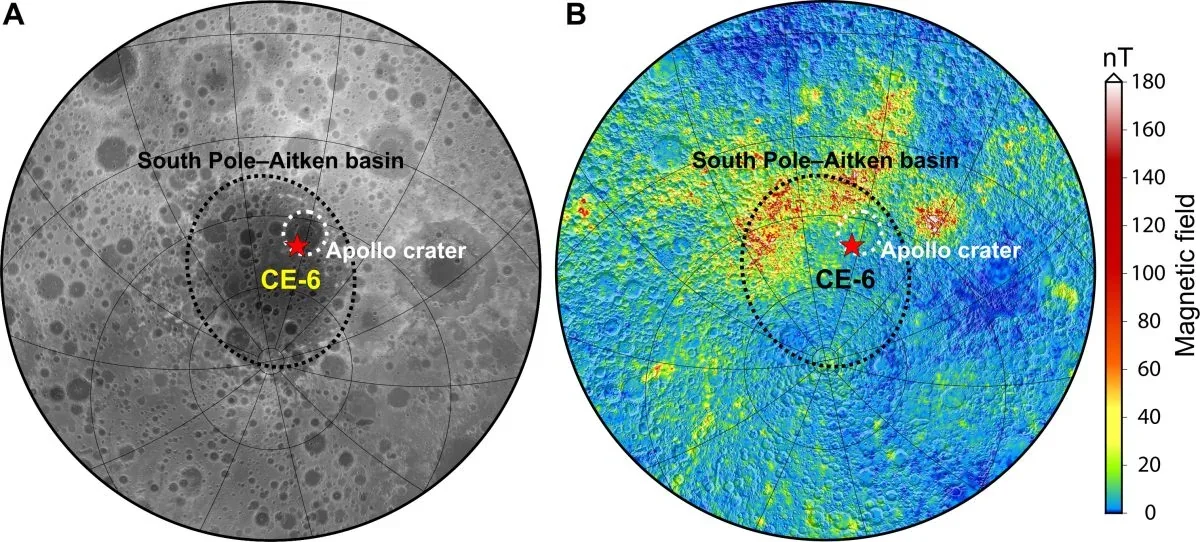
The research, conducted by an international team of scientists led by Professor Long Li from the Institute of Geochemistry at the Chinese Academy of Sciences (CAS), focused on impact-melt glass beads collected from the South Pole–Aitken (SPA) basin—the oldest and largest known impact crater on the Moon. Using advanced transmission electron microscopy and synchrotron radiation analysis, researchers identified nanoscale iron inclusions with unambiguous face-centered cubic structures.
Unlike previous Apollo missions that sampled only the near side of the Moon, Chang’e-6 touched down directly in the Apollo crater within the SPA basin. The unique geological setting exposed rock and dust that had endured intense shock pressures and extreme thermal cycles. In several samples, γ-Fe was not merely a trace anomaly; it was the dominant crystalline phase of iron present within the glass matrix.
Violent Impacts and the Phenomenon of ‘Magnetic Fossils’
How could an ultra-high-temperature phase of iron survive for billions of years without converting into ordinary iron? The researchers determined that during violent cosmic collisions, target rocks vaporized and melted at temperatures well above 1,000°C. As turbulent debris plumed outward, molten droplets quenched at staggering rates—cooling by thousands of degrees per second.
This rapid quenching kinetically trapped the atoms before they could rearrange into an α-Fe configuration. Furthermore, the surrounding silicate glass acted as a rigid thermodynamic pressure vessel, preventing thermal relaxation. As scientists continue to explore potential asteroid collisions with the Moon and their broader impacts on the Earth-Moon system, these pristine samples demonstrate how cataclysmic impacts fundamentally transform planetary mineralogy.
Crucially, magnetic characterization revealed that these γ-Fe nanoparticles exhibit persistent ferromagnetic properties even at room temperature. Because the Moon lacks an active global dynamo today, these tiny metallic inclusions function as frozen “magnetic fossils.” They capture the direction and strength of the Moon’s ancient magnetic field at the exact moment the impact glass solidified, bridging a multi-billion-year gap in our understanding of how lunar magnetism evolved.
Understanding these magnetic traces also connects directly with broader questions regarding Earth’s formation and deep geological history, as both bodies experienced intense bombardment during the solar system’s tumultuous youth.