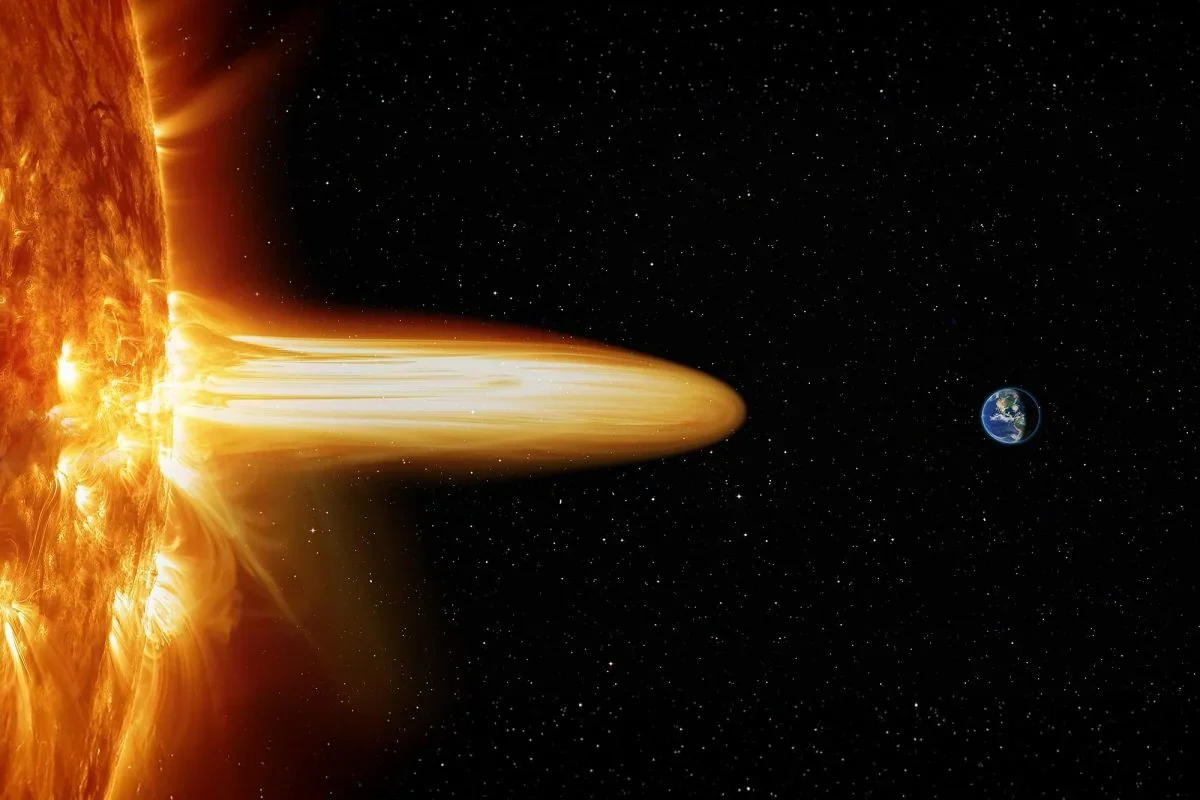
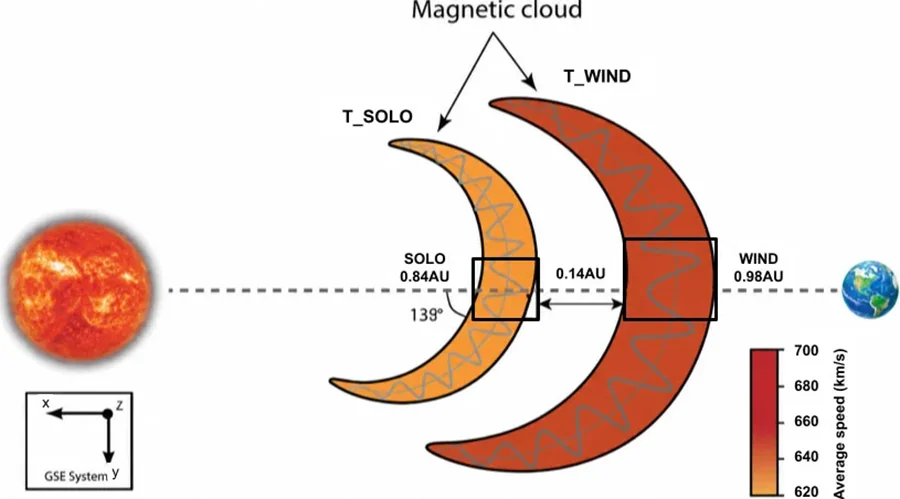
A massive plasma cloud launched by a violent eruption on the Sun behaved in an unexpected manner as it crossed interplanetary space toward Earth. Rather than cooling and dispersing gradually as standard astrophysical models predict, the coronal mass ejection (CME) underwent a phenomenon scientists describe as “super-expansion”—swelling in volume by more than 21% and tripling its internal core temperature across a stretch of just 21 million kilometers.
The discovery, led by astrophysicists at the University of Iowa using simultaneous data from the European Space Agency’s Solar Orbiter and NASA’s Wind spacecraft, has raised significant concerns among space weather forecasters. Super-expanding CMEs carry substantially greater momentum and magnetic pressure, dramatically escalating the threat of severe geomagnetic storms capable of crippling orbital satellites, disrupting aviation GPS, and overwhelming ground power grids.
Tracking a Solar Beast with Two Spacecraft
Coronal mass ejections are gigantic bubbles of magnetized plasma ejected from the Sun’s outer atmosphere during solar flares. On average, they travel through the solar wind at velocities between 300 and over 2,000 kilometers per second. Until recently, scientists could only observe these structures from isolated vantage points, forcing them to rely on theoretical approximations regarding how CMEs evolve along their journey to Earth.
The unique orbital alignment between Solar Orbiter (positioned relatively close to the Sun) and the Wind spacecraft (positioned near the Earth-Sun L1 Lagrange point) provided an extraordinary opportunity. When the CME swept past Solar Orbiter, instruments measured its dimensions, magnetic field configuration, and thermal properties. Hours later, when the exact same magnetic flux rope collided with Wind, the team recorded astonishing deviations.
Why Super-Expansion Challenges Space Weather Forecasting
Traditional hydrodynamic models predict that as a magnetized plasma cloud expands into the near-vacuum of interplanetary space, its internal gas should cool through adiabatic expansion. In this event, however, the plasma core experienced intense internal heating, nearly tripling in temperature. Researchers hypothesize that violent magnetic reconnection events within the flux rope converted stored magnetic energy directly into kinetic and thermal energy, driving internal acceleration.
The implications for Earth are profound. Understanding solar dynamics and catastrophic coronal outbursts provides crucial context for predicting long-term solar evolution, including dramatic cosmic milestones such as how Earth will be swallowed or torn apart by the Sun in the distant stellar future. In the near term, as Solar Cycle 25 reaches its peak, refined modeling of super-expanding CMEs will be vital to safeguarding modern telecommunications, satellite constellations, and continental power distribution networks from catastrophic blackouts.