Drifting silently through interstellar space just 7.5 light-years from our Solar System is WISE 0855—a frigid, solitary world with no host star and no daylight. Despite having a surface temperature hovering near minus 13 degrees Celsius (8°F), this sub-stellar object is far from dormant. For the very first time, astronomers utilizing the James Webb Space Telescope (JWST) have obtained direct, time-resolved evidence of dynamic water clouds in an extrasolar atmosphere, watching them thicken and dissipate across an 11-hour observing window.
This landmark discovery marks the first time that active water meteorology—a phenomenon fundamental to Earth’s climate and hydrologic cycle—has been directly mapped on an alien world beyond our Solar System.
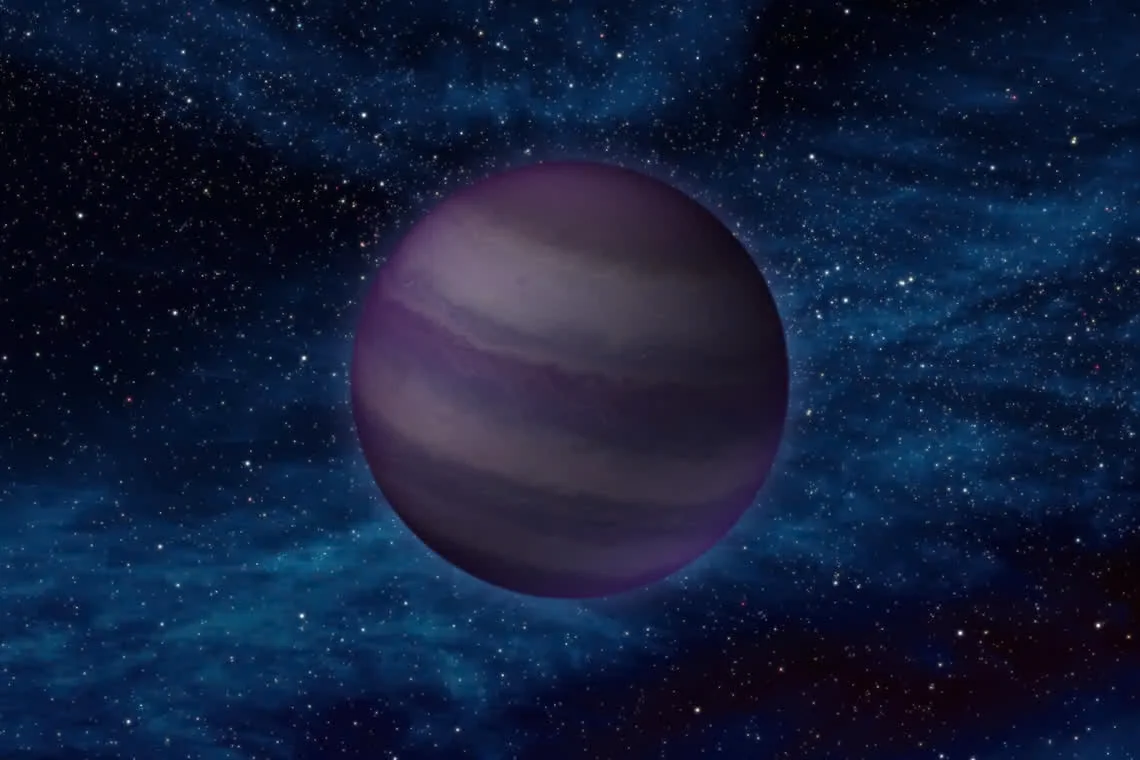
A Frigid World at the Boundary of Stars and Planets
Discovered in 2014 by NASA’s Wide-field Infrared Survey Explorer (WISE), WISE 0855 is classified as a cold Y-dwarf—the lowest-temperature class of brown dwarfs known to science. Possessing a mass approximately three to ten times that of Jupiter, WISE 0855 formed through gravitational gas-cloud collapse like a star, but lacked sufficient mass to ignite stable hydrogen fusion in its core.
Because it lacks stellar irradiation, WISE 0855’s atmospheric temperature profile closely mirrors that of our solar system’s gas giants. While warmer exoplanets boast clouds of vaporized silicates, iron rain, or molten salts, WISE 0855 is uniquely cold enough for atmospheric water vapor to condense into genuine water-ice crystals. Like other free-floating rogue planets discovered across the cosmos, it drifts alone in the galaxy, providing an untainted natural laboratory where atmospheric dynamics can be studied without blinding stellar glare.
Watching Alien Weather in Real Time
The research team, led by Dr. Brittany Miles from the University of Arizona’s Steward Observatory, aimed JWST’s Near-Infrared Spectrograph (NIRSpec) and Mid-Infrared Instrument (MIRI) at WISE 0855 for 11 continuous hours—roughly equivalent to one full rotational period of the object. High-precision spectroscopy detected periodic brightness fluctuations at wavelengths between 4.5 and 5 microns, a spectral window uniquely sensitive to water absorption and cloud opacity.
The data demonstrated that cloud decks on WISE 0855 are not static, uniform sheets. Instead, the atmosphere features patchy, localized weather fronts where thick water-ice cloud banks form through convective updrafts and subsequently break apart as dry atmospheric air subsides, strikingly reminiscent of mid-latitude storm tracks on Earth and Jupiter.
This breakthrough demonstrates the unprecedented resolving power of JWST to investigate extraterrestrial meteorology. By studying atmospheric circulation, cloud microphysics, and chemical disequilibria on isolated planetary-mass bodies, scientists are sharpening the analytical toolkits needed to identify biosignatures and assess habitability on rocky exoplanets in the decades ahead.