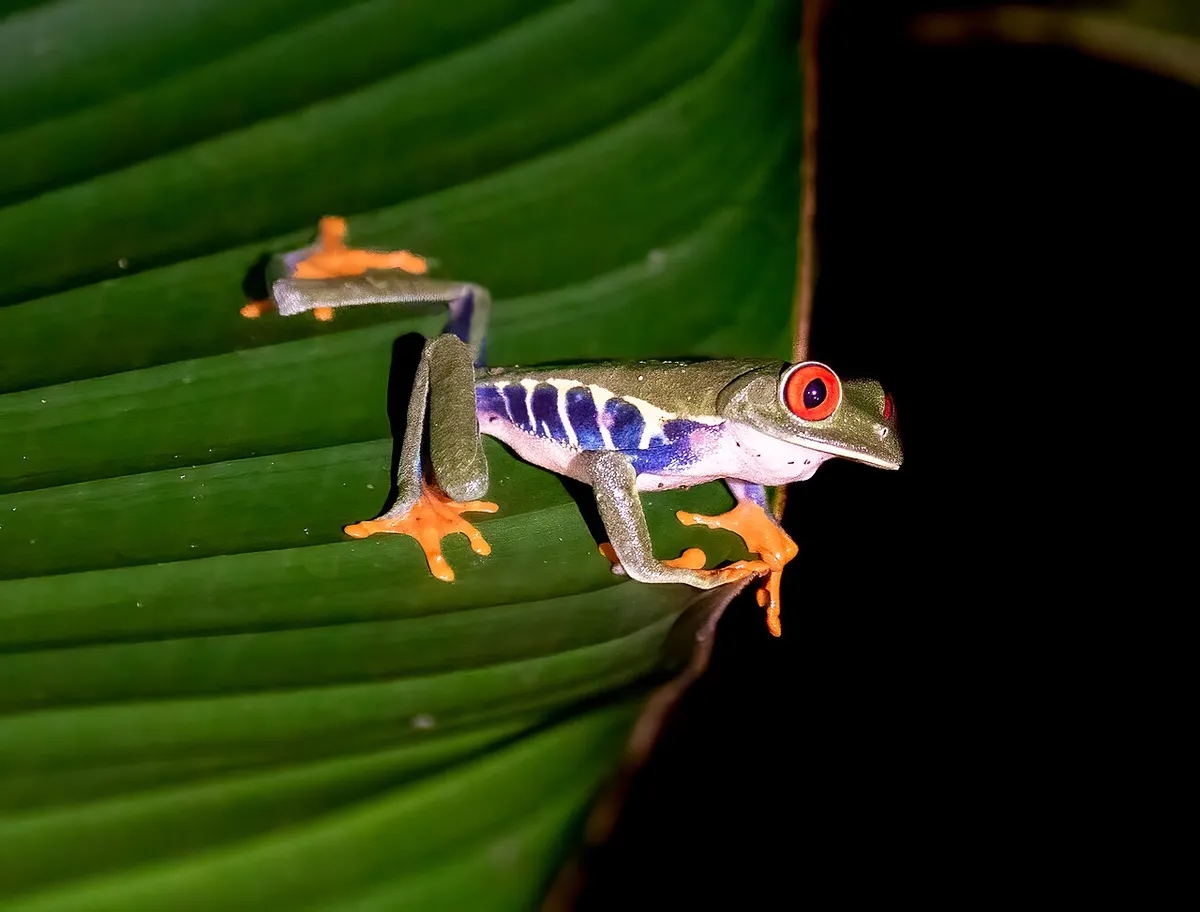
Snakes, frogs, turtles, and lizards are surrounded by centuries of folklore. Separate fact from fiction in 10 questions—or admire one of the world’s most striking serpents in our Rainbow Boa profile.
Question 1 of 10
Touching a toad gives people warts.
Myth. Human warts are caused by human papillomaviruses (HPV), not by the bumpy skin glands of toads.
Question 2 of 10
Chameleons change color mainly to blend into whatever background they touch.
Myth. Chameleons primarily shift colors to regulate body temperature and communicate mood, stress, or courtship signals.
Question 3 of 10
How do snakes primarily ‘smell’ the air around them?
Snakes flick their forked tongues to collect airborne scent molecules and transfer them to the Jacobson’s organ on the roof of the mouth.
Question 4 of 10
Most frogs absorb water directly through their skin instead of drinking with their mouths.
Fact. Frogs absorb moisture through a specialized ‘drinking patch’ of permeable skin on their bellies and thighs.
Question 5 of 10
Which reptile has the strongest measured bite force of any living animal?
Saltwater crocodiles can bite down with roughly 3,700 pounds per square inch (psi) of force—far stronger than lions or great white sharks.
Question 6 of 10
A turtle can crawl out of its shell if the shell gets too small.
Myth. A turtle’s shell is fused directly to its spine and rib cage, so it grows with the animal for life and cannot be removed.
Question 7 of 10
What makes amphibians different from reptiles?
Amphibians (frogs, salamanders, caecilians) have permeable, scaleless skin and typically undergo metamorphosis from aquatic larvae.
Question 8 of 10
Some geckos can walk up smooth vertical glass using microscopic hair-like structures on their toes.
Fact. Millions of tiny setae on gecko toe pads create van der Waals molecular attraction, letting them cling to smooth surfaces without glue.
Question 9 of 10
For many sea turtles and crocodilians, what determines whether hatchlings become male or female?
Temperature-dependent sex determination means warmer or cooler nest sand temperatures guide whether embryos develop as male or female.
Question 10 of 10
All snakes lay eggs.
Myth. Around 20% of snake species—including boas, sea snakes, and many vipers—give birth to live young.
Want to sharpen your field ID skills? Read how to tell venomous snakes from non-venomous ones and share your score.