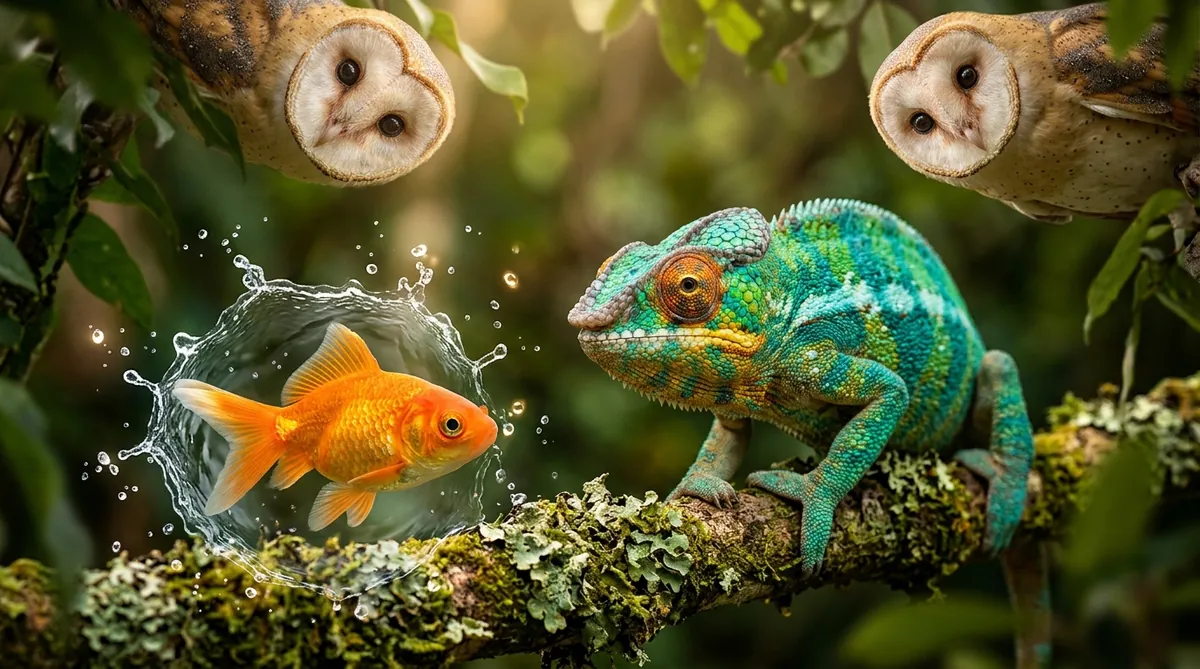
Some animal “facts” we all grew up with are pure myth. Others sound made up but are completely true. Read each statement below and decide: myth or fact? Every answer comes with a short explanation, and you get your score at the end.
Question 1 of 10
Goldfish only have a three-second memory.
Myth. Experiments show goldfish can remember sounds, colors and feeding routines for months, and they can even be trained to push a lever for food.
Question 2 of 10
Wombats produce cube-shaped poop.
Fact. The final part of a wombat’s intestine has stiff and stretchy sections that shape its droppings into cubes. Wombats stack them on rocks and logs to mark their territory.
Question 3 of 10
Bats are blind.
Myth. All bats can see. Many small bats also use echolocation to hunt in the dark, while large fruit bats rely mostly on good eyesight and a strong sense of smell.
Question 4 of 10
Camels store water in their humps.
Myth. A camel’s hump is a store of fat, not water. Camels survive long dry spells because they lose very little water and can drink a huge amount at once when they find it.
Question 5 of 10
Sharks have been around longer than trees.
Fact. The oldest shark fossils are about 450 million years old. The first true trees appeared roughly 385 million years ago, so sharks had a head start of more than 60 million years.
Question 6 of 10
If you touch a baby bird, its parents will abandon it.
Myth. Most birds have a weak sense of smell and will not reject a chick because a human touched it. If you find a fallen nestling, it is fine to put it gently back in its nest.
Question 7 of 10
Bulls get angry when they see the color red.
Myth. Cattle cannot tell red from green. In a bullfight the bull charges at the movement of the cape, not its color.
Question 8 of 10
An octopus has three hearts.
Fact. Two hearts pump blood through the gills and a third pumps it to the rest of the body. Octopus blood is blue because it carries oxygen with a copper-based protein.
Question 9 of 10
Lemmings jump off cliffs in mass suicides.
Myth. The idea spread after the 1958 documentary “White Wilderness”, whose crew staged the scene. Lemming numbers do boom and crash, but they do not kill themselves on purpose.
Question 10 of 10
Ostriches bury their heads in the sand when they are scared.
Myth. Ostriches lay their eggs in shallow holes in the ground and lower their heads to turn them, which from far away looks like head-burying. When threatened, they run or lie flat on the ground.
How did you do? Share your score with friends and see who really knows their animals.