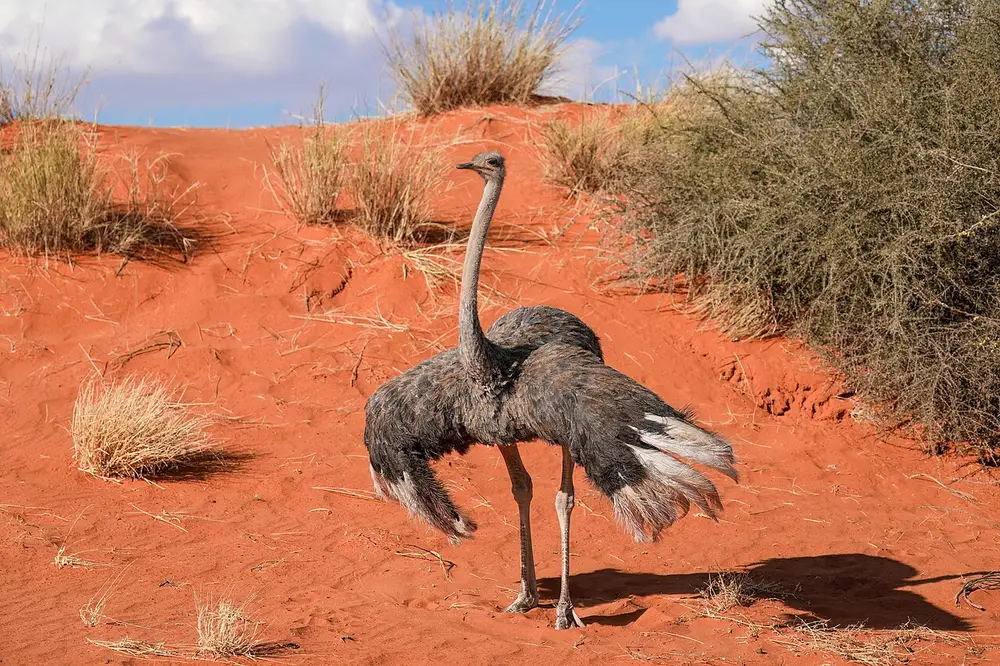
Trading the sky for speed, swimming, or island life produced some of Earth’s most unusual birds. Test your knowledge of flightless birds, and explore our Bird Trivia quiz.
Question 1 of 10
Which flightless bird is the fastest two-legged runner on Earth, reaching over 40 mph?
Ostriches sprint up to 43 mph (70 km/h) using powerful legs and only two toes on each foot.
Question 2 of 10
Which heavy, nocturnal parrot of New Zealand is the only flightless parrot in the world?
The critically endangered kakapo is a plump, moss-green nocturnal parrot that climbs trees and glides short distances.
Question 3 of 10
Ostriches bury their heads in sand whenever they feel threatened.
Myth. Ostriches lower their heads to turn eggs in shallow ground nests or lie flat to hide—never burying their heads.
Question 4 of 10
Which penguin species is the tallest and heaviest, breeding during the harsh Antarctic winter?
Emperor penguins stand nearly 4 feet tall, and males balance a single egg on their feet for two months in winter.
Question 5 of 10
Why do southern cassowaries wear a prominent helmet-like ‘casque’ on top of their heads?
Scientists link the keratin-covered casque to pushing through rainforest undergrowth, thermoregulation, and sound resonance.
Question 6 of 10
Emus are native to Australia and can swim across rivers when needed.
True. Emus are strong swimmers and fast runners native to mainland Australia.
Question 7 of 10
Which extinct flightless bird of Mauritius became a famous symbol of human-driven extinction in the 1600s?
The dodo, a large relative of pigeons, vanished from Mauritius within a century of European arrival due to hunting and introduced predators.
Question 8 of 10
Where do Galapagos flightless cormorants use their tiny wings?
Having evolved without land predators, Galapagos cormorants swim with their webbed feet and use stubby wings for balance.
Question 9 of 10
Male emus and male rheas—not the females—incubate the eggs and raise the chicks.
True. After females lay eggs in the nest, fathers sit on the clutch for weeks and guard the hatchlings.
Question 10 of 10
Which island-dwelling flightless bird holds the record for the largest egg relative to its own body size (~20% of its weight)?
A female kiwi lays an enormous egg that takes up a huge portion of her abdomen before laying.
Prefer colorful flying birds? Check out our guide on different types of parakeets.