Earth’s continents drift slowly every year, building tension that occasionally snaps in powerful earthquakes. Test your tectonic knowledge, and check out our Earth & Geology quiz.
Question 1 of 10
What is the point directly on Earth’s surface above where an earthquake begins underground?
The underground rupture point is the focus (hypocenter), while the point straight above it on the surface is the epicenter.
Question 2 of 10
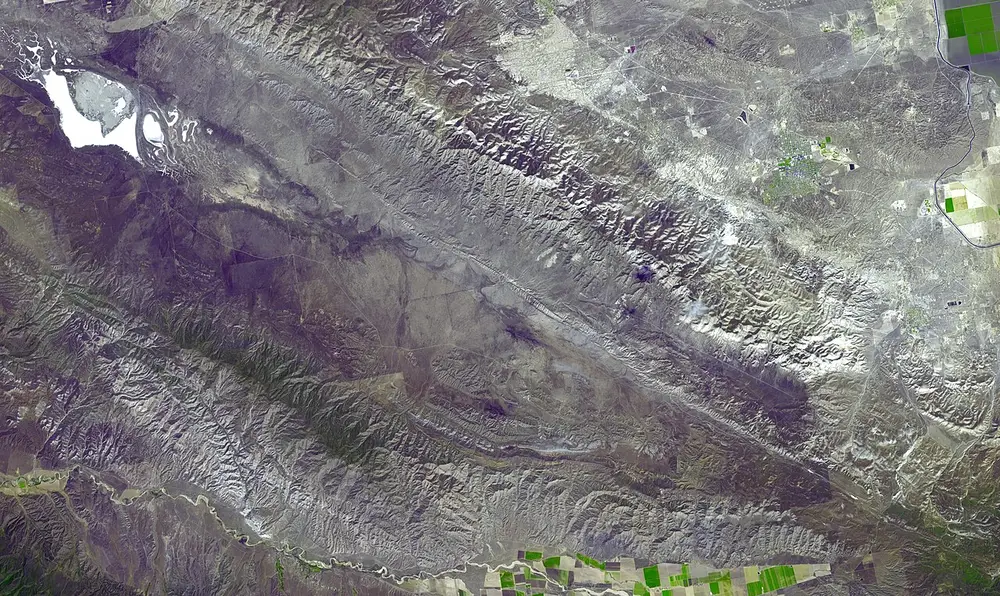
Which famous transform fault runs roughly 800 miles through California between the Pacific and North American plates?
The San Andreas Fault marks the boundary where the Pacific Plate slides northwest past the North American Plate.
Question 3 of 10
There is a specific ‘earthquake weather’—hot, dry, and still—that triggers major quakes.
Myth. USGS confirms earthquakes begin miles underground and have no connection to surface temperature, clouds, or weather.
Question 4 of 10
Roughly how fast do Earth’s tectonic plates typically move each year?
Most tectonic plates drift 1 to 10 centimeters per year—roughly matching how fast human fingernails grow.
Question 5 of 10
Which German scientist first proposed the theory of continental drift and the supercontinent Pangaea in 1912?
Alfred Wegener noticed matching coastlines, rock belts, and identical fossils across the Atlantic Ocean.
Question 6 of 10
Underwater earthquakes that abruptly lift or drop the seafloor can trigger ocean-wide tsunamis.
True. Sudden vertical displacement of a massive water column sends fast-moving tsunami waves across entire ocean basins.
Question 7 of 10
Which scale replaced the older Richter scale for measuring the total energy released by very large modern earthquakes?
Seismologists use the Moment Magnitude (Mw) scale because it remains accurate for massive quakes where the Richter scale saturates.
Question 8 of 10
What instrument records ground vibrations during an earthquake?
A seismograph detects and records seismic P-waves, S-waves, and surface waves to pinpoint quake location and size.
Question 9 of 10
During an earthquake indoors, standing in a doorway is no longer considered the safest advice for modern buildings.
True. Safety agencies recommend ‘Drop, Cover, and Hold On’ under a sturdy table rather than standing in a doorway.
Question 10 of 10
Which country experienced the strongest earthquake ever recorded by instruments—a magnitude 9.5 quake in 1960?
The 1960 Valdivia earthquake in southern Chile reached magnitude 9.4–9.6, triggering tsunamis across the Pacific.
Curious how shifting Earth affects time itself? Read why Earth’s rotation is subtly changing.