Our nearest celestial neighbor governs ocean tides and stages dramatic eclipses across the sky. Test your lunar knowledge, and read about the Chang’e-6 lunar soil mystery.
Question 1 of 10
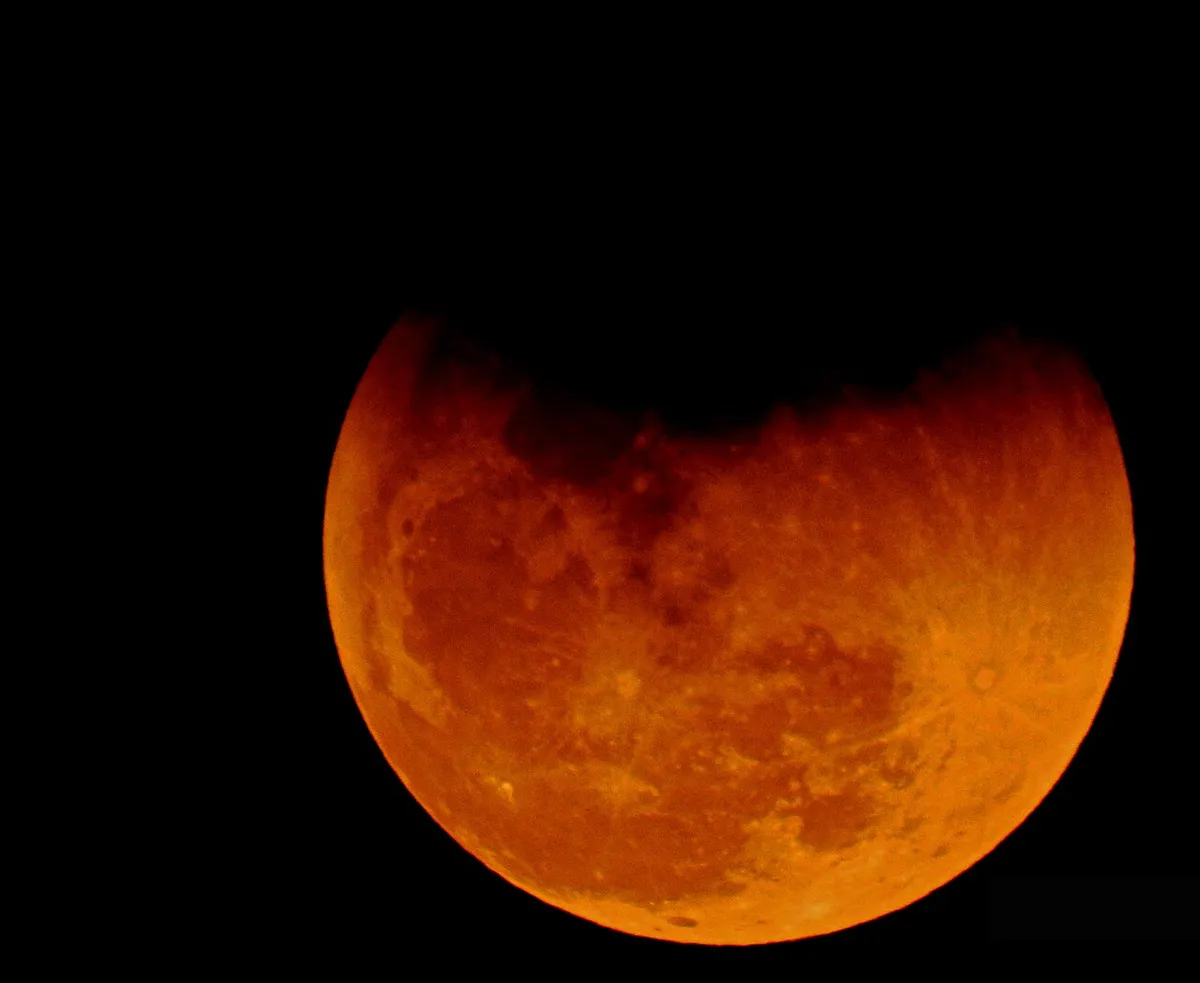
Why does the Moon appear copper-red during a total lunar eclipse (‘blood moon’)?
Earth’s atmosphere filters out shorter blue wavelengths and refracts red-orange light into Earth’s shadow—like all sunrises and sunsets at once.
Question 2 of 10
One side of the Moon is permanently dark and never receives sunlight.
Myth. The ‘far side’ gets just as much sunlight over each lunar month as the near side; it simply never faces Earth.
Question 3 of 10
How long does it take the Moon to complete one orbit around Earth (relative to the stars, or between full moons)?
The Moon orbits Earth in 27.3 days (sidereal month), while the cycle from full moon to full moon takes 29.5 days.
Question 4 of 10
Astronauts’ footprints on the Moon could last millions of years because there is no wind or rain to erase them.
True. Without an atmosphere or weather, only rare micrometeorite impacts slowly disturb lunar soil.
Question 5 of 10
Which celestial alignment causes a solar eclipse?
During a new moon, when the Moon lines up directly between Earth and the Sun, its shadow falls across parts of Earth.
Question 6 of 10
The Moon is slowly drifting away from Earth by roughly 1.5 inches (3.8 cm) every year.
True. Laser reflectors left by Apollo missions confirm tidal interactions gradually push the Moon outward.
Question 7 of 10
What are the large, dark flat plains on the Moon—once mistaken for seas by early astronomers—called?
Lunar maria (Latin for ‘seas’) are vast plains of ancient cooled basaltic lava.
Question 8 of 10
Roughly how strong is surface gravity on the Moon compared to Earth?
Lunar gravity is roughly 16.5% (about one-sixth) of Earth’s, letting astronauts bound easily across the surface.
Question 9 of 10
You should never look directly at a partial solar eclipse without certified ISO 12312-2 eclipse glasses.
True. Even a tiny sliver of exposed Sun can cause permanent retinal eye damage.
Question 10 of 10
Who were the first two humans to walk on the Moon during Apollo 11 in July 1969?
Neil Armstrong stepped onto the Sea of Tranquility first, followed shortly by Buzz Aldrin while Michael Collins orbited above.
Want more cosmic trivia? Try our Space & Universe Trivia quiz.