Every pebble, crystal, and gemstone carries clues about heat, pressure, and deep geological time. Test your rock and mineral trivia, and explore our Earth & Geology quiz.
Question 1 of 10
Which of the three main rock types forms from layers of sand, mud, or shells pressed and cemented together?
Sedimentary rocks like sandstone, shale, and limestone accumulate in layers and are the primary rocks that preserve fossils.
Question 2 of 10
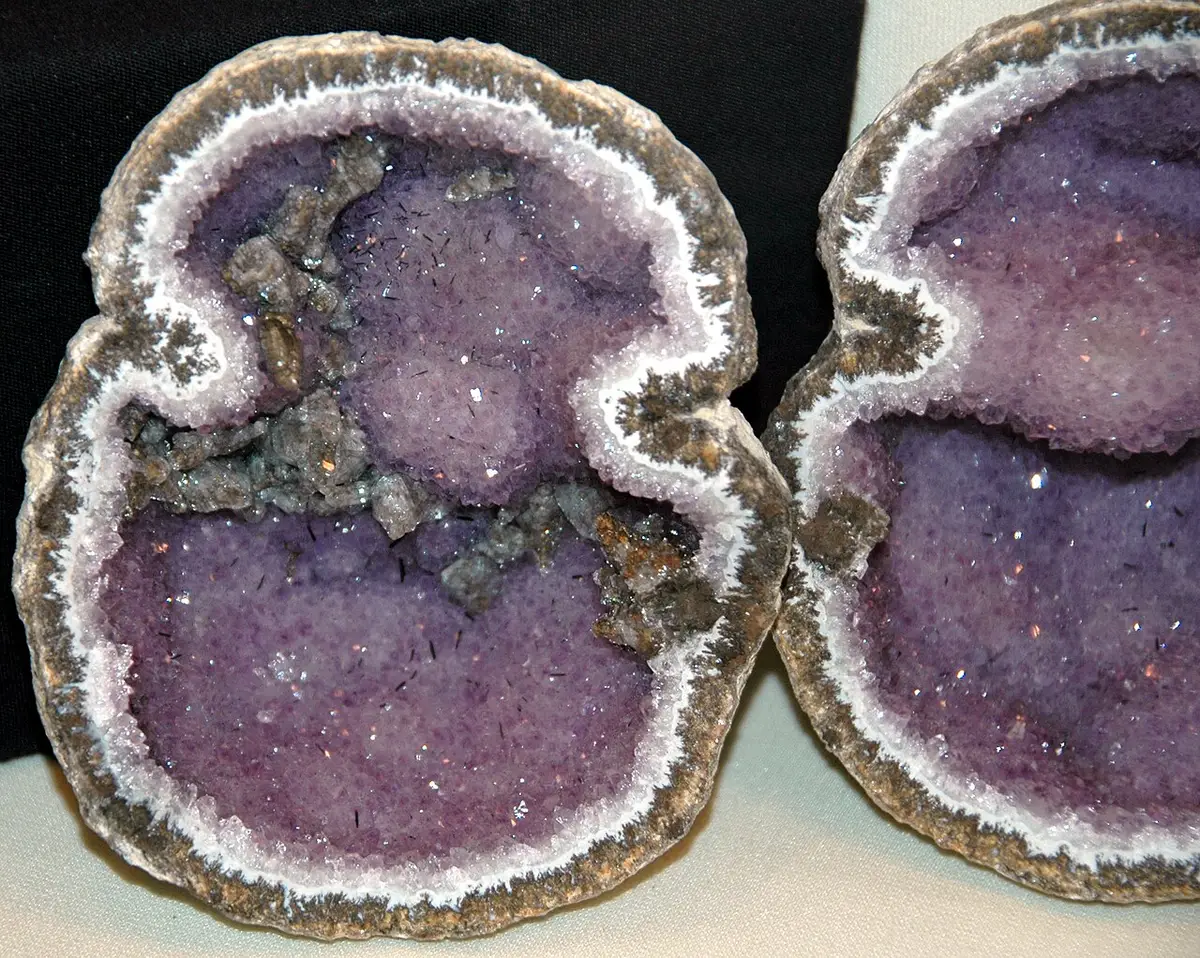
Amethyst, citrine, and rose quartz are all color varieties of which common mineral?
Trace impurities such as iron or manganese give silicon dioxide (quartz) its purple, yellow, or pink hues.
Question 3 of 10
Pearls and amber are technically classified as minerals because they are used in jewelry.
Myth. True minerals must be inorganic with a crystal structure; pearls come from oysters and amber is fossilized tree resin.
Question 4 of 10
What is obsidian—the glossy black stone prized for sharp ancient tools?
When silica-rich lava cools too quickly for crystals to grow, it solidifies into smooth volcanic glass.
Question 5 of 10
Which mineral is the softest on the Mohs hardness scale, rated 1 and used in talcum powder?
Talc sits at level 1 on Friedrich Mohs’s 1–10 scratch-hardness scale, easily scratched by a fingernail.
Question 6 of 10
Marble is a metamorphic rock formed when limestone is subjected to intense heat and pressure.
True. Heat and pressure recrystallize calcite in limestone into interlocking grains of marble.
Question 7 of 10
Why is pyrite commonly nicknamed ‘fool’s gold’?
Iron sulfide (pyrite) looks metallic yellow, though unlike malleable gold it is brittle and leaves a greenish-black streak.
Question 8 of 10
Which precious green gemstone is actually a variety of the mineral beryl?
Emerald is green beryl colored by trace chromium or vanadium, while blue beryl is aquamarine.
Question 9 of 10
Granite forms deep underground as magma cools slowly, allowing large visible crystals to grow.
True. Slow cooling beneath Earth’s surface gives quartz, feldspar, and mica crystals time to grow large.
Question 10 of 10
What does a mineral’s ‘streak test’ measure?
Even when a mineral varies in surface color, its powdered streak on a porcelain plate stays remarkably consistent.
Curious about rare planetary geology? Read about Madagascar’s lunar-like rock complex.