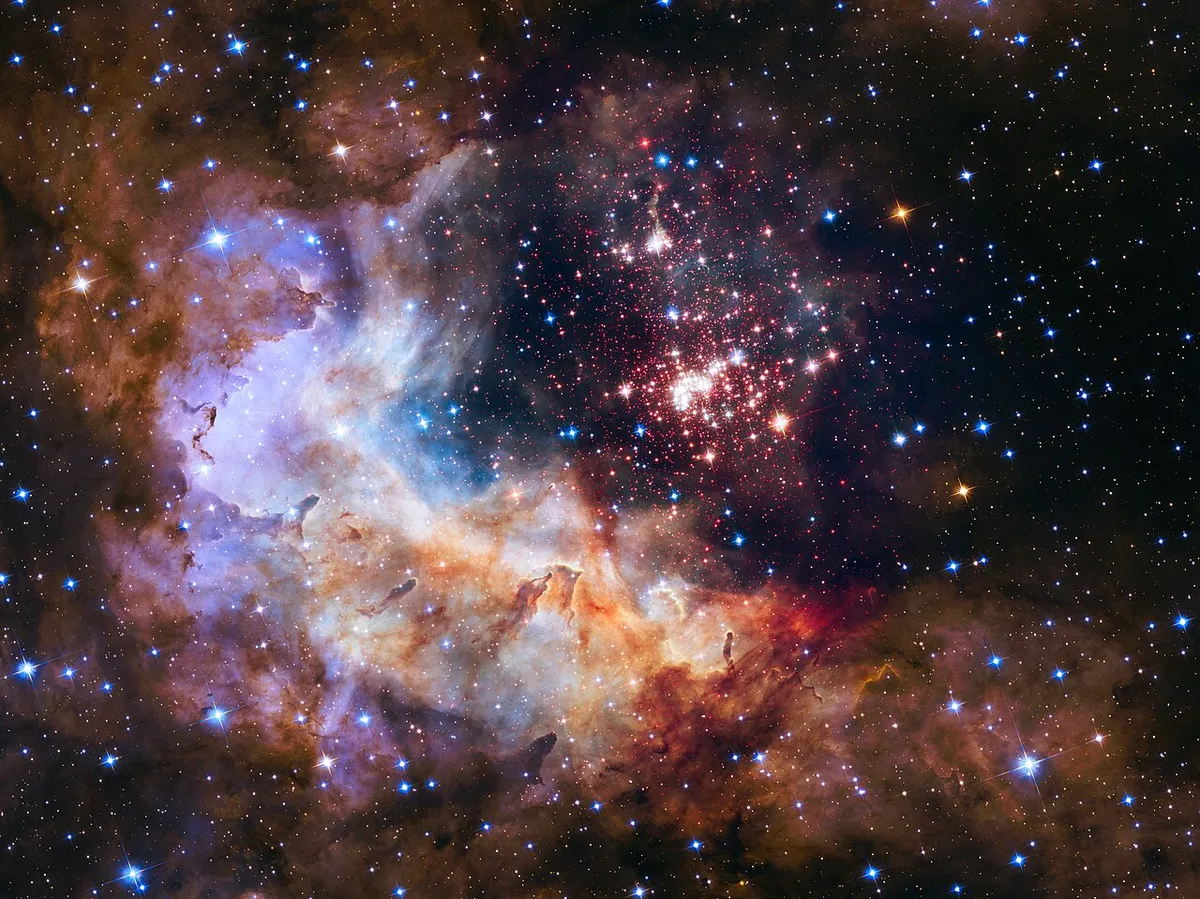
At the extremes of gravity and stellar death, the universe produces black holes, exploding stars, and ripples in spacetime. Test your astrophysics trivia, and play our Stars, Nebulae, and Constellations Quiz.
Question 1 of 10
What is the boundary around a black hole beyond which nothing—not even light—can escape?
Once matter or light crosses the event horizon, the escape velocity exceeds the speed of light.
Question 2 of 10
What is the name of the supermassive black hole at the center of our Milky Way galaxy?
In 2022, the Event Horizon Telescope released the first direct ring image of Sagittarius A*, weighing ~4 million suns.
Question 3 of 10
If our Sun magically turned into a black hole of the exact same mass, Earth would immediately be sucked inside.
Myth. Gravity at Earth’s orbit depends only on mass and distance—Earth would keep orbiting normally, just in freezing darkness.
Question 4 of 10
What happens when a massive star (at least ~8 times the Sun’s mass) runs out of core fuel and collapses violently?
A core-collapse supernova can briefly outshine an entire galaxy and forge heavy elements like gold and iron.
Question 5 of 10
What are ‘gravitational waves’ first directly detected by LIGO in 2015?
Predicted by Einstein, colliding black holes and neutron stars send faint ripples stretching and squeezing spacetime.
Question 6 of 10
Closer to a strong gravitational field like a black hole, time passes more slowly compared to regions far away.
True. Gravitational time dilation is a verified prediction of general relativity—even measurable on GPS satellites around Earth.
Question 7 of 10
What is ‘spaghettification’ near a black hole?
Gravity pulls much harder on the closer side of an object than the far side, stretching it into a long thin strand.
Question 8 of 10
What is a rapidly spinning, highly magnetized neutron star that sweeps beams of radiation past Earth like a lighthouse?
Discovered by Jocelyn Bell Burnell in 1967, pulsars tick with astonishing clock-like regularity.
Question 9 of 10
Many heavy elements in our bodies—like iron in blood and calcium in bones—were forged inside ancient stars and supernovae.
True. Stellar nucleosynthesis and explosive supernovae seeded space with the elements that built Earth and life.
Question 10 of 10
Which theorist predicted in 1974 that quantum effects near event horizons allow black holes to slowly emit radiation and evaporate?
Named Hawking radiation, this subtle quantum glow causes tiny black holes to evaporate faster than massive ones.
Want more cosmic mysteries? Explore our Space & Universe Trivia quiz.