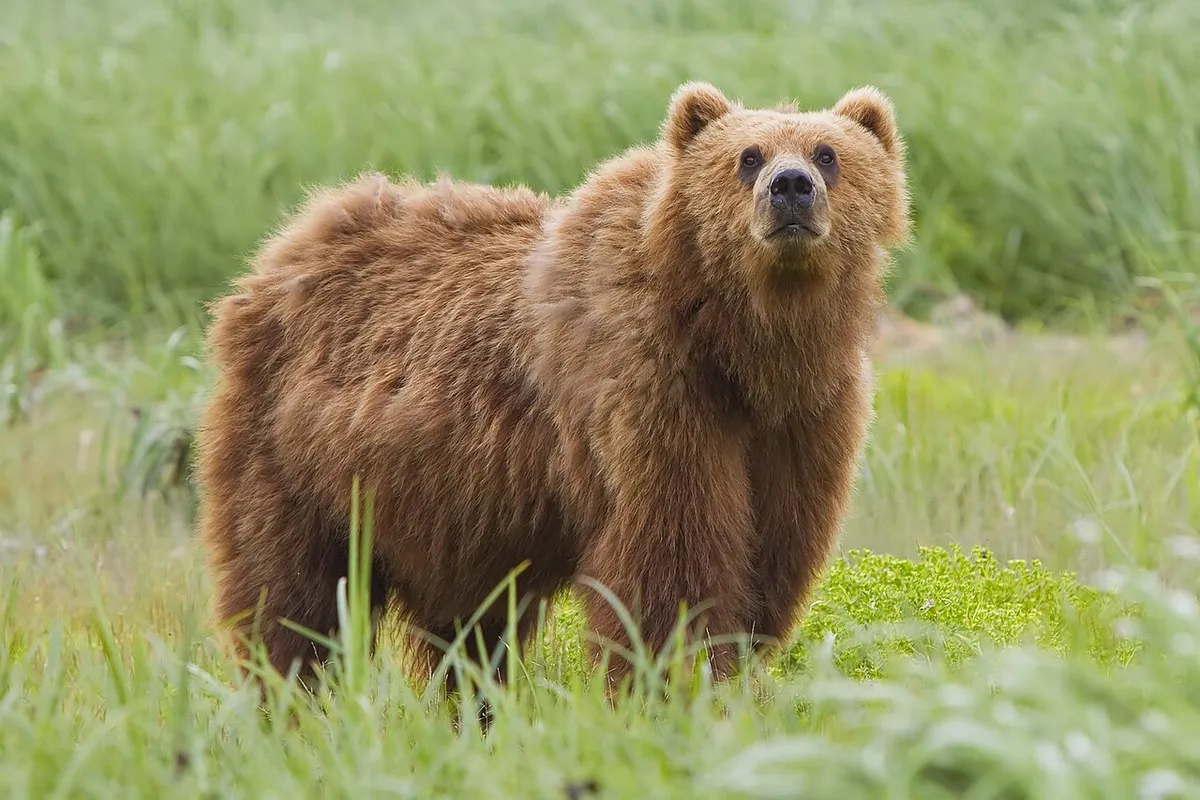
Eight bear species live across four continents, from Arctic sea ice to tropical cloud forests. Test your bear knowledge, and check out our wild animal encounter survival guide.
Question 1 of 10
Polar bears have black skin underneath their transparent, hollow guard hairs.
True. Their dark skin absorbs solar heat, while clear hollow hairs scatter light to appear white against snow.
Question 2 of 10
Which bear species is the smallest in the world?
Native to Southeast Asia, the sun bear averages only 60–150 pounds (27–68 kg), making it the smallest living bear.
Question 3 of 10
Giant pandas spend over half their day eating bamboo, yet they still possess the digestive system of a carnivore.
True. Giant pandas evolved from meat-eating ancestors and rely on gut microbes to extract energy from fibrous bamboo.
Question 4 of 10
Which bear species is the only one native to South America?
The spectacled bear lives along the Andes Mountains in South America and is named for the pale rings around its eyes.
Question 5 of 10
During winter hibernation, a bear’s heart rate drops dramatically, yet it does not urinate or defecate.
Fact. Hibernating bears recycle urea back into protein to preserve muscle mass while sleeping for months.
Question 6 of 10
Which bear species lives on sea ice and is classified as a marine mammal?
Polar bears depend on sea ice to hunt seals and are legally and ecologically classified as marine mammals.
Question 7 of 10
All eight living bear species are native to the Arctic or northern temperate forests.
False. Sun bears, sloth bears, and spectacled bears live in tropical or subtropical habitats across Asia and South America.
Question 8 of 10
What is a ‘grolar’ or ‘pizzly’ bear?
As warming temperatures shift ranges, rare wild hybrids between polar bears and grizzly bears have been documented.
Question 9 of 10
Grizzly bears cannot climb trees at any age.
Myth. Young grizzly cubs climb trees easily to escape danger, though heavy adults lose the ability due to straight claws and bulk.
Question 10 of 10
Which bear species has a long, curved snout and lacks upper front teeth so it can vacuum up termites and ants?
Sloth bears of India and Sri Lanka form a tube with their lips to suck up insects from mounds like a vacuum.
Want to test more outdoor safety instincts? Try our Wilderness Survival Skills Quiz.