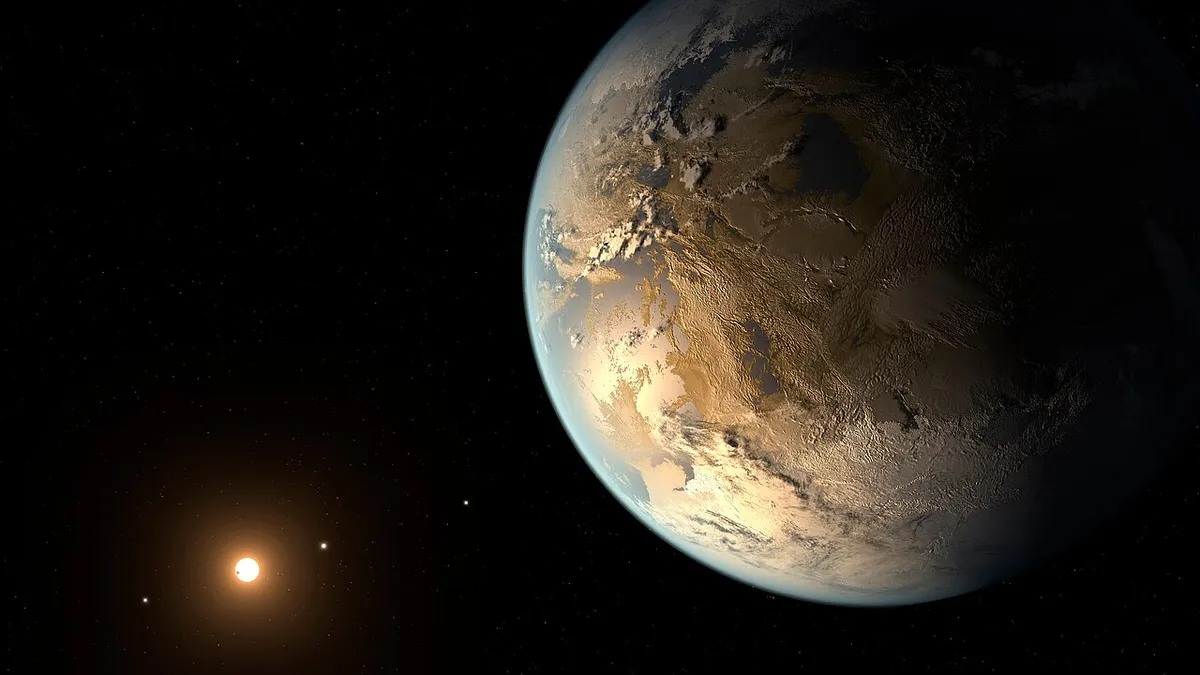
Astronomers have confirmed thousands of planets orbiting distant stars—including lava worlds, diamond-rich candidates, and rocky Earth-sized worlds. Test your exoplanet trivia, and read about lava-covered super-Earth TOI-561 b.
Question 1 of 10
What is an ‘exoplanet’?
Exoplanets (extrasolar planets) orbit stars other than our Sun, or drift freely as rogue planets.
Question 2 of 10
How does the ‘transit method’ (used by NASA’s Kepler and TESS telescopes) detect exoplanets?
When an exoplanet crosses in front of its star from our viewpoint, it blocks a tiny, rhythmic fraction of starlight.
Question 3 of 10
A planet orbiting inside a star’s ‘habitable zone’ (Goldilocks zone) is guaranteed to have oceans and alien life.
Myth. The habitable zone only means surface temperatures *could* allow liquid water if the right atmosphere exists.
Question 4 of 10
Which nearby planetary system has seven Earth-sized rocky planets tightly orbiting an ultra-cool red dwarf star?
About 40 light-years away, all seven TRAPPIST-1 planets fit closer to their star than Mercury sits from our Sun.
Question 5 of 10
What are ‘hot Jupiters’?
Hot Jupiters whip around their host stars in just a few days, reaching blistering temperatures above 1,000°C.
Question 6 of 10
Most confirmed exoplanets discovered so far were found indirectly rather than through direct camera photographs.
True. Stars outshine planets by millions or billions of times, so transit and radial-velocity methods find most exoplanets.
Question 7 of 10
What is a ‘rogue planet’?
Ejected from young solar systems or formed alone in nebulae, rogue planets wander interstellar space.
Question 8 of 10
What does ‘super-Earth’ mean when describing an exoplanet?
The term refers strictly to mass and size (roughly 1 to 10 Earth masses)—not whether the world is Earth-like or habitable.
Question 9 of 10
Astronomers can sometimes analyze the gases in an exoplanet’s atmosphere using spectroscopy when starlight filters through it.
True. Transmission spectroscopy reveals chemical fingerprints like water vapor, methane, or carbon dioxide.
Question 10 of 10
Which exoplanet discovered in 1995 was the first confirmed planet orbiting a Sun-like star?
Michel Mayor and Didier Queloz won the 2019 Nobel Prize in Physics for discovering 51 Pegasi b.
Curious about rogue worlds without stars? Read how Webb detected water clouds on a rogue world.