Mars is the most explored planet beyond Earth, studied by orbiters, landers, and robotic rovers. Test your Red Planet knowledge, and read why Mars became a frigid desert.
Question 1 of 10
What gives Mars its signature rusty-red color?
Iron-rich minerals in Martian rocks oxidized billions of years ago, coating the planet in fine iron oxide dust.
Question 2 of 10
What are the names of Mars’s two small, potato-shaped moons?
Named after the Greek mythological sons of Ares (fear and panic), Phobos and Deimos orbit close to Mars.
Question 3 of 10
A day on Mars (a ‘sol’) is almost the same length as an Earth day—about 24 hours and 39 minutes.
True. Mars’s rotation period is only ~39 minutes longer than Earth’s, though its year is nearly twice as long (687 Earth days).
Question 4 of 10
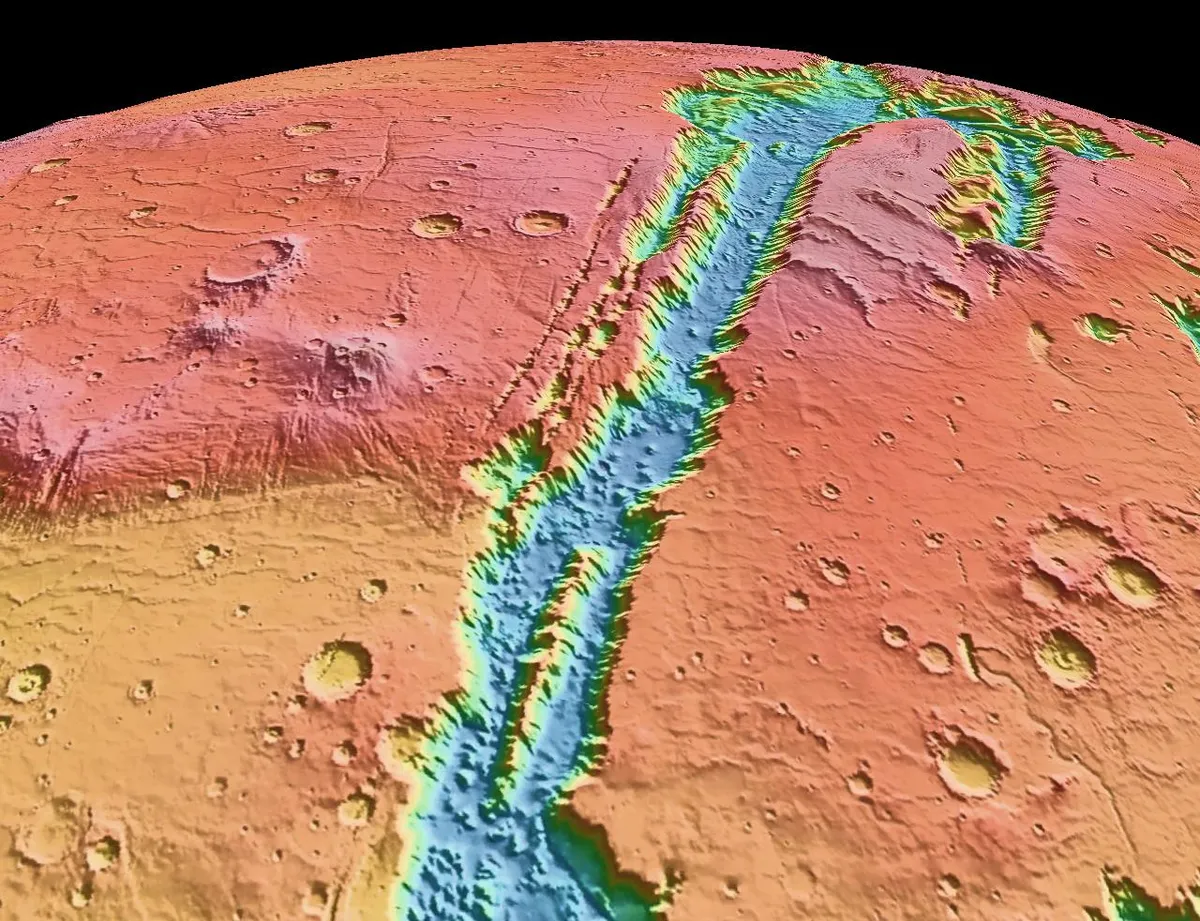
Which massive canyon system on Mars stretches over 2,500 miles—nearly the width of the United States?
Valles Marineris is roughly five times deeper and ten times longer than Earth’s Grand Canyon.
Question 5 of 10
What gas makes up over 95% of Mars’s thin atmosphere?
Mars’s tenuous atmosphere is about 95% carbon dioxide, with surface pressure less than 1% of Earth’s.
Question 6 of 10
Mars has a warm, breathable atmosphere at its equator during summer.
Myth. Even on a warm Martian summer afternoon, temperatures plunge below -70°C at night and the air is unbreathable CO2.
Question 7 of 10
Which NASA helicopter made history on Mars by completing 72 powered flights in thin Martian air?
Delivered by the Perseverance rover, Ingenuity achieved the first powered, controlled flight on another planet in 2021.
Question 8 of 10
What are Mars’s bright white polar ice caps composed of?
Mars’s poles hold permanent water ice topped by seasonal layers of dry ice that freeze and sublimate each year.
Question 9 of 10
Ancient river deltas and lakebeds on Mars show that liquid water once flowed on its surface billions of years ago.
True. Rovers like Curiosity and Perseverance found clay minerals, rounded pebbles, and ancient lake sediments.
Question 10 of 10
Which NASA rover landed in Jezero Crater in 2021 to search for signs of ancient microbial life and collect rock samples?
Perseverance has been caching core samples in Jezero Crater, an ancient lakebed with a preserved river delta.
Thinking about future Mars missions? Check out the scientific reality check on terraforming Mars.