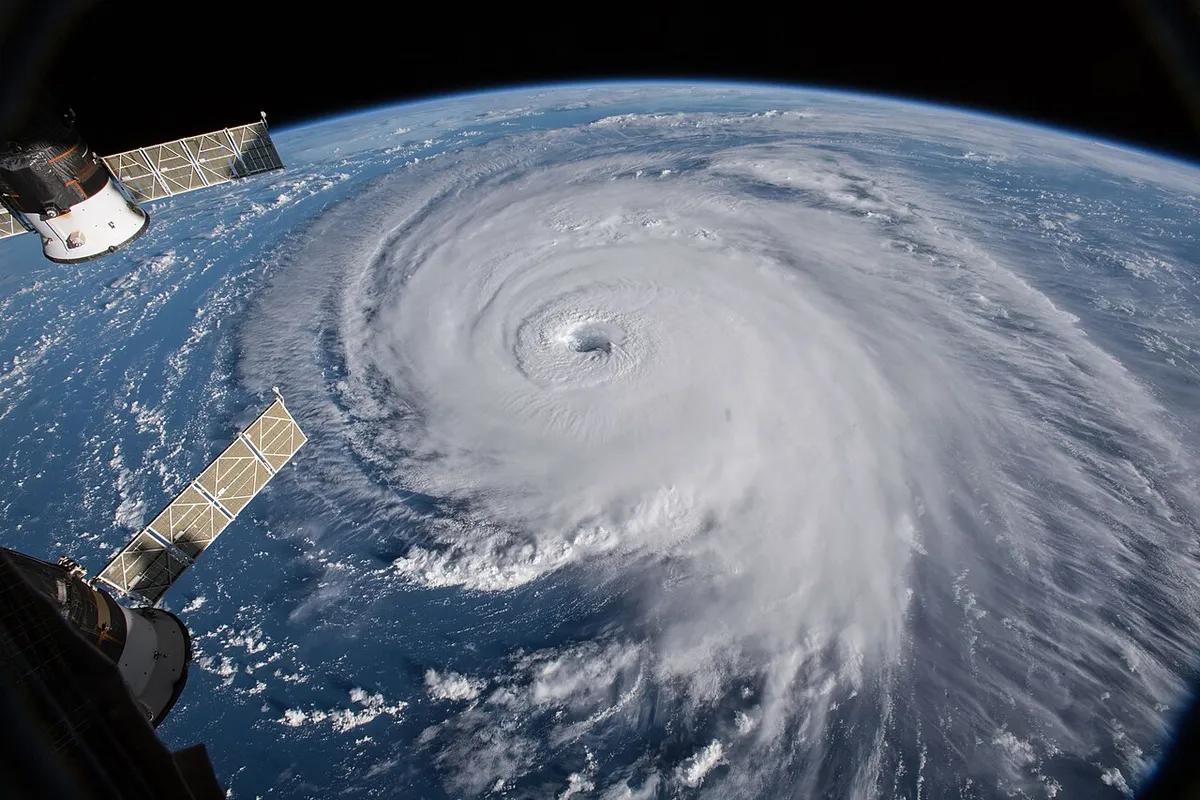
From superheated lightning bolts to spinning hurricanes, Earth’s atmosphere drives some of the most powerful forces in nature. Test your weather knowledge in 10 questions, and read how climate shifts can even affect Earth’s rotation.
Question 1 of 10
Which gas makes up the second-largest share of Earth’s dry atmosphere after nitrogen?
Dry air is about 78% nitrogen and 21% oxygen, with argon and trace gases making up the remaining 1%.
Question 2 of 10
Lightning never strikes the same place twice.
Myth. Tall structures like the Empire State Building and CN Tower are struck by lightning dozens of times every year.
Question 3 of 10
Which scale do meteorologists use to rate tornado intensity based on estimated wind damage?
The Enhanced Fujita (EF) scale rates tornadoes from EF0 to EF5 by analyzing structural and vegetation damage to estimate wind speeds.
Question 4 of 10
The eye of a strong hurricane is the region with the fastest, most violent winds.
False. The eye is a relatively calm, clear center of low pressure; the fiercest winds occur in the surrounding eyewall.
Question 5 of 10
Which towering cloud type produces thunderstorms, heavy rain, lightning, and hail?
Cumulonimbus clouds are dense vertical storm clouds fueled by strong updrafts, capable of reaching the top of the troposphere.
Question 6 of 10
A bolt of lightning can heat the surrounding air to around 50,000°F (27,700°C)—roughly five times hotter than the surface of the Sun.
Fact. According to the National Weather Service, lightning superheats air to around 50,000°F, and the rapid expansion creates thunder.
Question 7 of 10
In the Northern Hemisphere, which direction do low-pressure hurricane winds rotate around the center?
Due to the Coriolis effect from Earth’s rotation, tropical cyclones spin counterclockwise in the Northern Hemisphere and clockwise in the Southern Hemisphere.
Question 8 of 10
Why does a severe thunderstorm produce large hailstones?
Powerful storm updrafts carry frozen droplets high into supercooled cloud regions, adding layers of ice until the hailstone becomes too heavy to stay aloft.
Question 9 of 10
Atmospheric pressure normally decreases as altitude increases.
True. Higher up in the atmosphere, there is less overlying air pressing down, so air pressure and density steadily drop.
Question 10 of 10
Which instrument is specifically used to measure atmospheric pressure?
A barometer measures air pressure, helping meteorologists track approaching high- and low-pressure weather systems.
Want to explore storms beyond Earth’s atmosphere? Check out our report on a monster solar storm heading toward Earth and share your quiz score.