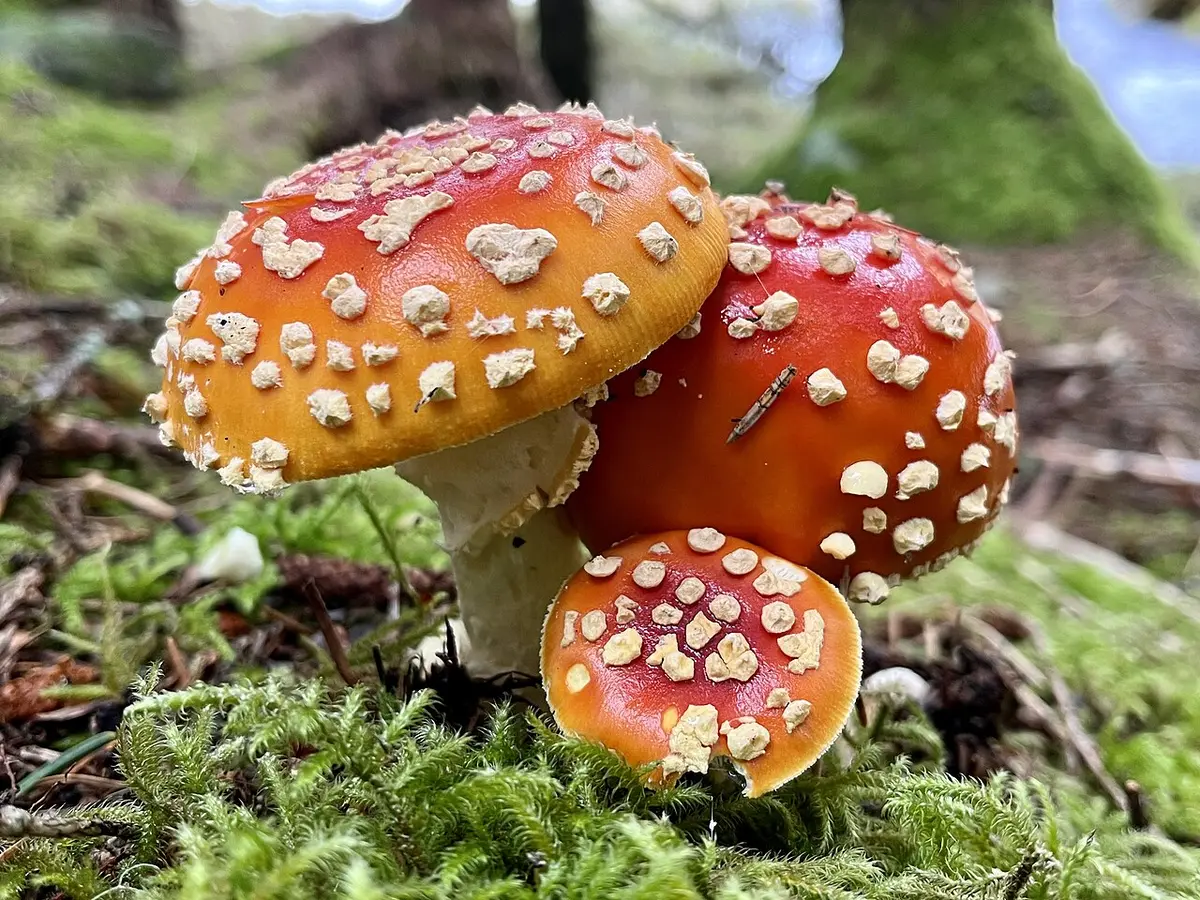
Neither plants nor animals, fungi form their own kingdom that recycles forests and feeds trees underground. Test your mycology trivia, and play our Plants & Trees Quiz.
Question 1 of 10
Biologically speaking, are fungi more closely related to plants or to animals?
Like animals, fungi cannot photosynthesize, store energy as glycogen, and share a more recent evolutionary ancestor with animals.
Question 2 of 10
What is the vast underground web of thread-like fungal fibers that makes up most of a fungus’s body?
Mushrooms are just temporary spore-producing fruits; the main living organism is the branching mycelium network.
Question 3 of 10
If you pick a poisonous wild mushroom, cooking or boiling it always makes it safe to eat.
Myth. Deadly mushroom toxins like amatoxins in death caps survive boiling, freezing, and drying completely intact.
Question 4 of 10
What is a ‘lichen’—often seen as crusty gray, green, or orange patches on rocks and tree bark?
Lichens are symbiotic partnerships where a fungus provides shelter and minerals while algae or cyanobacteria photosynthesize food.
Question 5 of 10
Which famous antibiotic was discovered in 1928 by Alexander Fleming from a Penicillium mold?
A stray Penicillium notatum mold spore landed on Fleming’s petri dish and killed surrounding Staphylococcus bacteria.
Question 6 of 10
One of the largest known living organisms on Earth by area is a honey mushroom mycelium spreading across thousands of acres in Oregon.
True. Nicknamed the ‘Humongous Fungus,’ an Armillaria ostoyae colony spans roughly 2,385 acres in Malheur National Forest.
Question 7 of 10
What do yeast—single-celled fungi—produce that makes bread dough rise?
Yeast ferments sugars into carbon dioxide gas and alcohol, inflating dough pockets.
Question 8 of 10
How do underground mycorrhizal fungi help forest trees thrive?
Fungal threads extend far beyond tree roots to gather phosphorus and water, receiving photosynthetic sugars in return.
Question 9 of 10
Mushrooms carry out photosynthesis using green chlorophyll.
False. Fungi have no chlorophyll and absorb nutrients by breaking down organic matter or partnering with plants.
Question 10 of 10
What prized underground culinary fungus grows symbiotically on oak and hazelnut roots and is hunted using trained dogs?
Black and white truffles emit powerful aromas to attract mammals that dig them up and spread their spores.
Want more forest-floor wonders? Explore our Ancient Trees and Forest Giants Quiz.