At about 5 p.m. on October 27, 1915, Ernest Shackleton ordered his men off their ship. The Endurance had been locked in the sea ice of the Weddell Sea for nine months, and the ice was now crushing her. Twenty-eight men stepped onto a floating sheet of ice, far from land, with no one coming to look for them.
All 28 came home. This is how they did it, from the first months in the ice to the discovery of the wreck, almost intact, in 2022. (Antarctica’s cold and ice also fill several questions in our quiz on nature’s record-breaking extremes.)
At a glance
- Who
- Ernest Shackleton and the 27 men of the Endurance
- What
- The Imperial Trans-Antarctic Expedition
- Where
- Weddell Sea, Elephant Island and South Georgia
- When
- December 1914 to August 1916
- Outcome
- Ship lost, every man of the Weddell Sea party survived
A plan to cross Antarctica
By 1914 the South Pole had already been reached, so Shackleton chose a different goal: the first crossing of the Antarctic continent on foot. One party would land on the Weddell Sea coast and sledge across the continent. A second group, the Ross Sea party, would sail to the opposite side and lay supply depots for the final stretch.
For the Weddell Sea party Shackleton bought a Norwegian ship, built as Polaris and launched in December 1912, for £14,000. He renamed her Endurance after his family motto, Fortitudine Vincimus (“by endurance we conquer”). Her captain, Frank Worsley, later called her “the finest little wooden vessel ever built.”
More than 5,000 people applied to join the expedition. The famous newspaper advertisement promising “small wages, bitter cold, long months of complete darkness” is almost certainly a myth; no copy of it has ever been found. On December 5, 1914, Endurance left the whaling station at Grytviken, South Georgia, with 28 men (one of them a stowaway, Perce Blackborow), 69 sled dogs and a cat named Mrs Chippy.
Trapped in the Weddell Sea
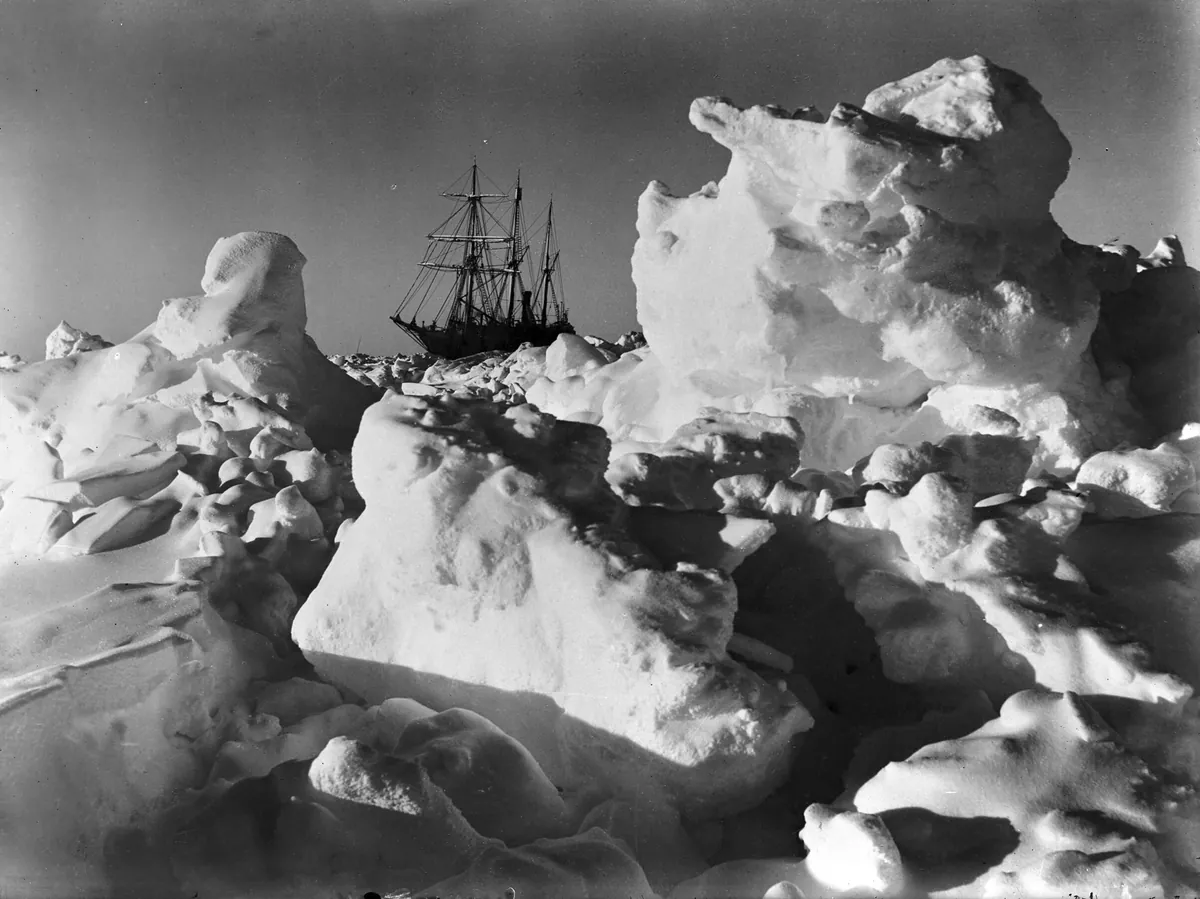
Two days out of South Georgia the ship met pack ice. Worsley worked her south through the floes, but by January 24, 1915, Endurance was frozen in, short of the coast where the shore party was meant to land.
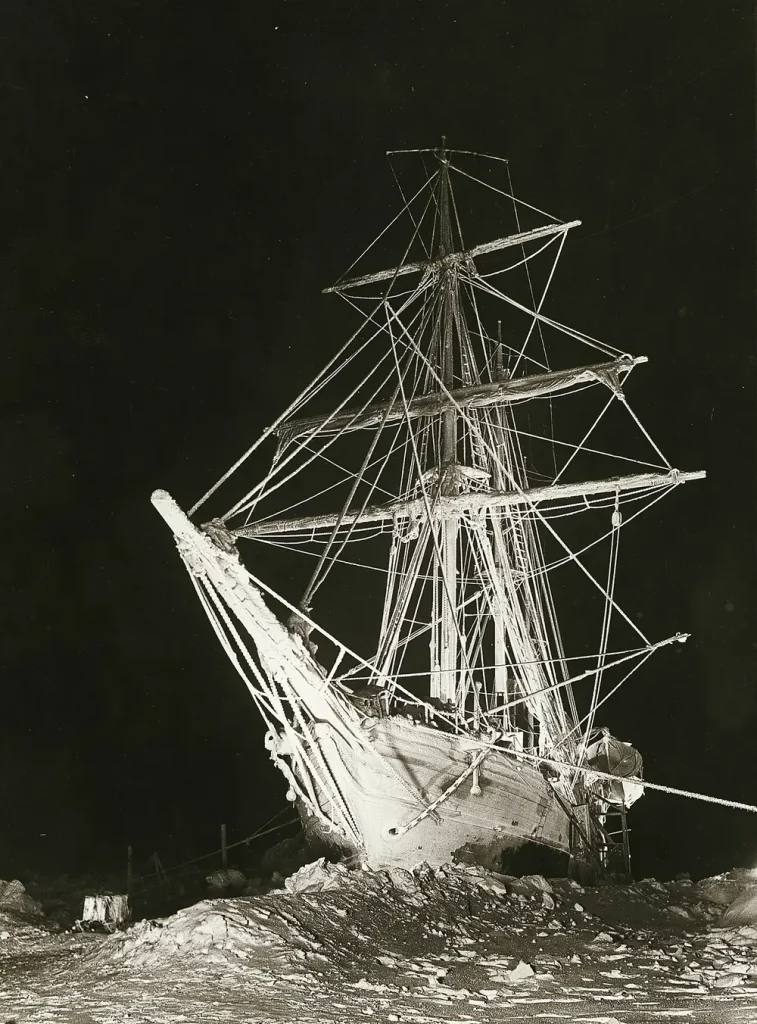
The ship drifted with the ice for the rest of the southern winter. The men lived aboard through the dark months. Then, as spring came, the pressure of the ice began to squeeze the hull. Timbers cracked, the sternpost was torn away and water poured in. On October 27, 1915, Shackleton gave the order to abandon ship.
Life on the ice
The crew salvaged everything they could carry. Frank Hurley, the expedition photographer, recovered his glass plate negatives from the wreck. Of about 550 plates, he kept the best 120, the most the party could carry, and smashed the rest.
Shackleton tried to march the men toward land, hauling the lifeboats over the ice. The surface was a maze of ridges; after seven days they had covered seven and a half miles, and they gave up. Before setting out he ordered the weakest animals shot, including Mrs Chippy, who belonged to the carpenter, Harry McNish.
The men settled on a large floe they called Ocean Camp. On November 21, 1915, they watched Endurance finally slip under the ice. They later moved to a second floe, Patience Camp, and lived there for more than three months while the ice drifted slowly north.
497 days without land
In early April 1916 the floe under Patience Camp split apart. The men took to the three lifeboats, named after the expedition’s sponsors: the James Caird, the Dudley Docker and the Stancomb Wills. For about a week they rowed and sailed through freezing spray and drifting ice.
On April 15, 1916, they landed on Elephant Island, a bare rock off the tip of the Antarctic Peninsula. It was the first solid ground they had stood on in 497 days. Frank Wild, Shackleton’s second in command, later wrote that by then “at least half the party were insane.”
Elephant Island was safe from the sea, but nobody would find them there. Whalers almost never passed it. Shackleton decided to take one boat and go for help.
Eight hundred miles in a lifeboat
The nearest place with people who could help was the whaling stations on South Georgia, about 800 miles (1,300 km) away across the Southern Ocean, some of the roughest water on Earth. McNish adapted the 22.5-foot James Caird for the open ocean, improvising tools and materials on the beach.
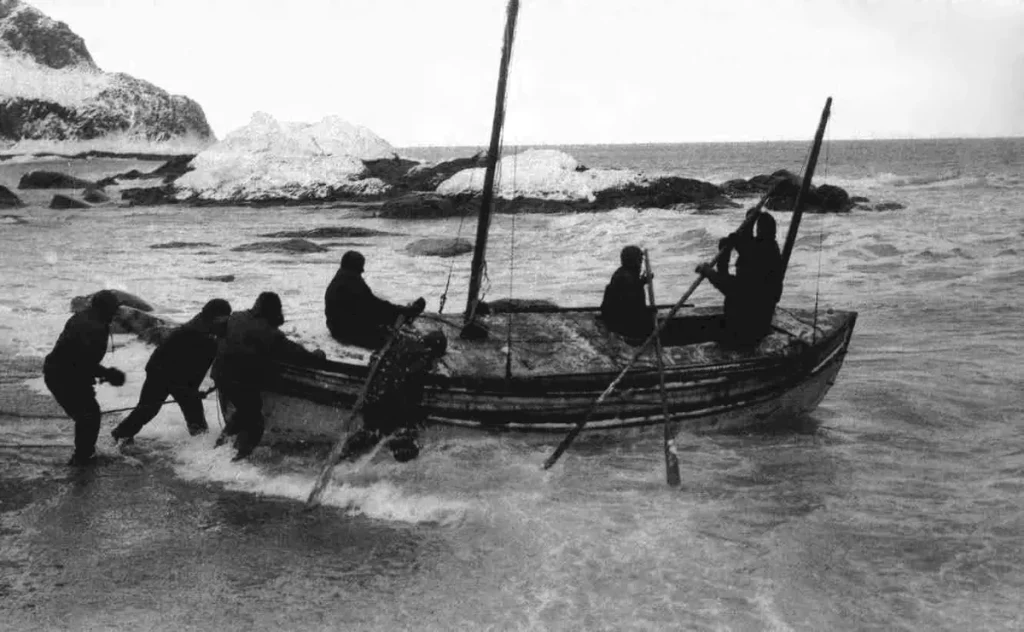
On April 24, 1916, six men set out: Shackleton, Worsley, Tom Crean, McNish, and the sailors John Vincent and Timothy McCarthy. Worsley navigated by the sun on the rare occasions it showed through the cloud. As they neared South Georgia, Worsley had gone 80 hours without sleep.
After about 16 days at sea, and a last struggle against hurricane-force winds, they landed at King Haakon Bay. It was the wrong side of the island. The whaling stations were on the north coast, and the James Caird was in no shape to sail around.
The walk across South Georgia
Leaving McNish, Vincent and McCarthy in an upturned boat, Shackleton, Worsley and Crean set off across the island’s unmapped mountains and glaciers. They walked for about 36 hours with almost no rest.
At 7 a.m. on May 20, 1916, they heard the steam whistle at Stromness whaling station calling the men to work. Later that day three ragged men walked into the station. The manager, Thoralf Sørlle, had known Shackleton before the expedition but did not recognize him. “My name is Shackleton,” he said.
All three men later wrote that during the crossing they had felt a fourth person walking with them. T. S. Eliot borrowed the image for a passage of his poem The Waste Land.
The rescue of the 22
McNish, Vincent and McCarthy were picked up the next day. The 22 men on Elephant Island were harder to reach. Shackleton tried three times, in a British whaler, a Uruguayan ship and a Chilean schooner, and each time the pack ice turned him back.
On Elephant Island, Frank Wild kept the men going. They lived under the two remaining boats, turned upside down on low stone walls, and ate penguins and seals. Every morning Wild told the others to “lash up and stow,” ready to leave at once.
The fourth attempt worked. The Chilean Navy lent Shackleton a small steam tug, the Yelcho, commanded by Luis Pardo. On August 30, 1916, the fog lifted, the men on the beach saw the ship, and within an hour all 22 were aboard. Not one man of the Weddell Sea party had died. The Ross Sea party, on the other side of the continent, was less lucky: three of its men died laying depots for a crossing that never came.
Finding the Endurance
Shackleton went south one more time. He died of a heart attack aboard his ship at South Georgia on January 5, 1922, aged 47, and he is buried at Grytviken, where the Endurance voyage began.
For a century the ship lay somewhere under the Weddell Sea. In March 2022 the Endurance22 expedition, led by John Shears, found her at a depth of 3,008 meters (9,869 feet), about four miles from the position Worsley had recorded when she sank. She was in remarkable condition. The name ENDURANCE is still readable across her stern, above a five-pointed star.
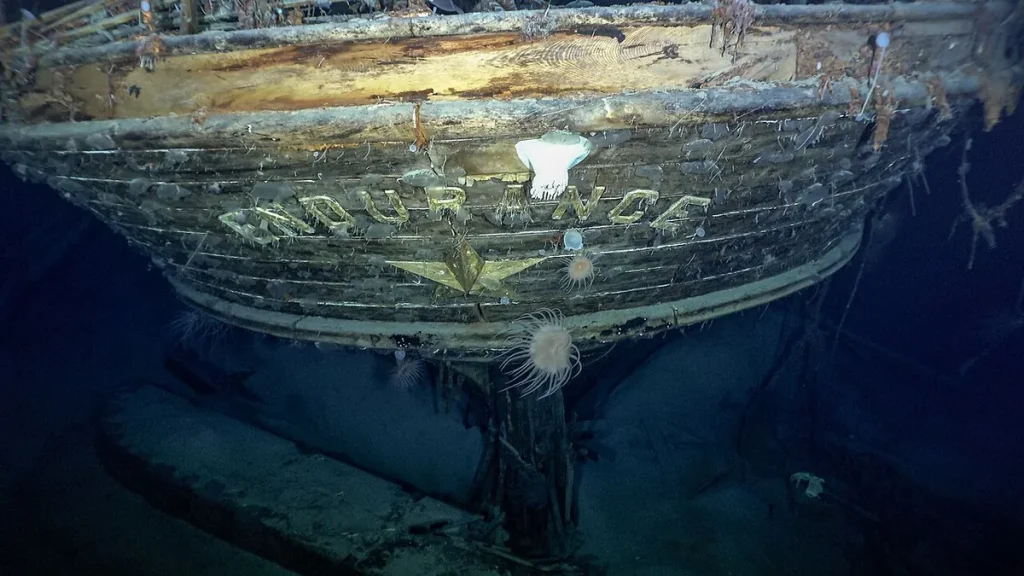
The wreck is protected under the Antarctic Treaty and will not be raised. The closest most travelers get to this corner of the world is the Antarctic Peninsula, where small expedition ships take visitors each southern summer. Another story from the same decade continues in our true story of Balto and the 1925 serum run.
Test yourself: Endurance quiz
Question 1 of 5
What was Shackleton’s goal for the expedition?
Cross Antarctica on foot. The South Pole had already been reached in 1911, so Shackleton aimed for the first crossing of the continent.
Question 2 of 5
Where did the crew first reach land after the ship was lost?
Elephant Island, on April 15, 1916, after 497 days without setting foot on land.
Question 3 of 5
How far did the James Caird sail to reach South Georgia?
About 800 miles (1,300 km), across some of the roughest water on Earth, in about 16 days.
Question 4 of 5
Which ship finally rescued the men on Elephant Island?
Yelcho, a small Chilean Navy tug commanded by Luis Pardo, on August 30, 1916.
Question 5 of 5
How deep was the wreck of the Endurance when it was found in 2022?
About 3,000 meters. The wreck lies at 3,008 meters (9,869 feet) in the Weddell Sea.
Sources
- The Stunning Survival Story of Ernest Shackleton and His Endurance Crew, Kieran Mulvaney, History.com, updated September 2026
- Shackleton’s Endurance, Endurance22
- Imperial Trans-Antarctic Expedition, Wikipedia
- Endurance (1912 ship), Wikipedia
Featured image: Endurance trapped in the Weddell Sea pack ice, 1915. Photo: Frank Hurley, public domain, via Wikimedia Commons.