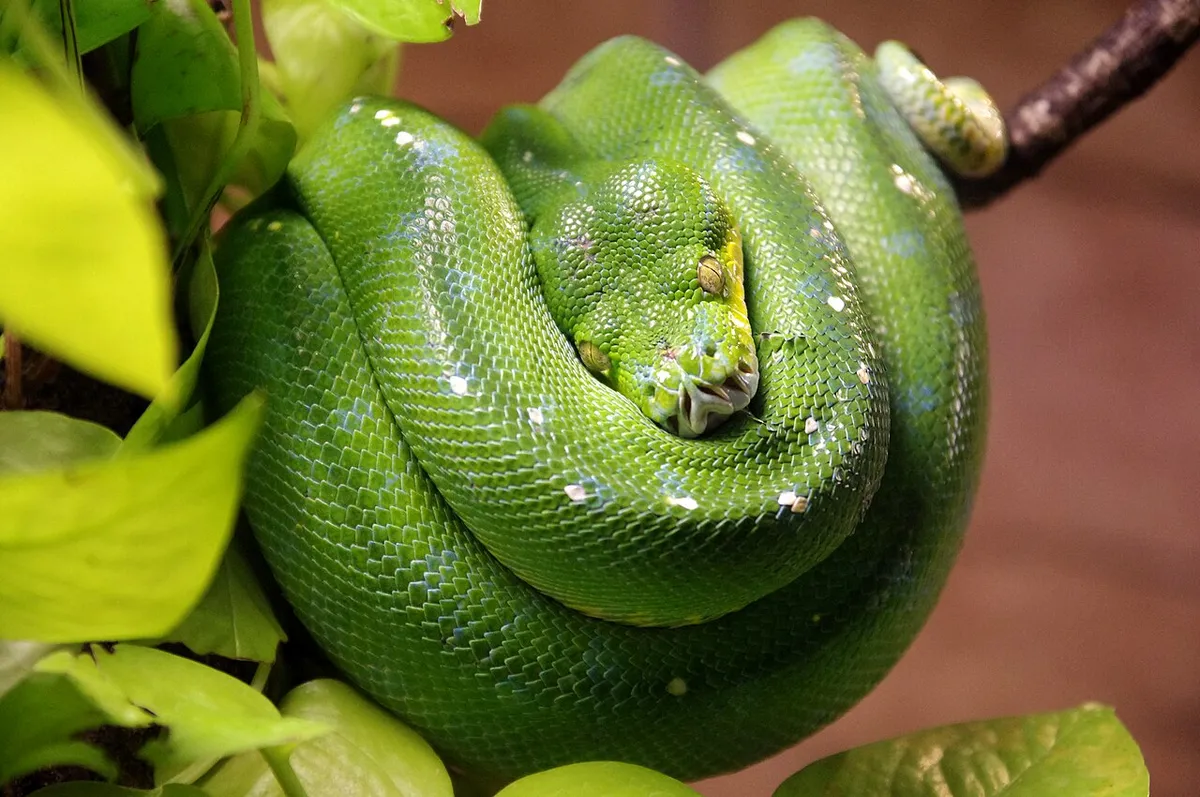
Few animals inspire as many tall tales as snakes. Separate folklore from biology in 10 questions, and learn how to tell venomous snakes from non-venomous ones.
Question 1 of 10
Snakes literally unhinge or dislocate their jawbones to swallow large prey.
Myth. Snakes do not dislocate their jaws; instead, stretchy ligaments connect independent lower jaw halves that walk over prey.
Question 2 of 10
Which snake is the longest venomous snake species in the world, reaching up to 18 feet?
King cobras of South and Southeast Asia are the longest venomous snakes, capable of raising a third of their body off the ground.
Question 3 of 10
Do snakes have eyelids they can blink to clean their eyes?
Snakes lack movable eyelids; a transparent spectacle scale (brille) covers each eye and sheds along with their skin.
Question 4 of 10
Most snake species on Earth are harmless to humans and lack venom dangerous to people.
True. Out of roughly 4,000 known snake species, only around 15–20% possess venom medically dangerous to humans.
Question 5 of 10
Which Southeast Asian snakes can flatten their ribs and glide between rainforest treetops?
Flying snakes (genus Chrysopelea) launch from high branches, flatten into a concave ribbon, and undulate through the air.
Question 6 of 10
Rattlesnakes always add exactly one new rattle segment per year, revealing their exact age.
Myth. Rattlesnakes add a segment every time they shed—which can happen multiple times a year—and older segments often break off.
Question 7 of 10
What is the heaviest snake species in the world by body mass?
While reticulated pythons can grow slightly longer, South America’s green anaconda is far thicker and heavier, exceeding 500 pounds.
Question 8 of 10
How do pit vipers such as rattlesnakes and copperheads detect warm-blooded prey in total darkness?
Infrared-sensitive pit organs detect tiny temperature differences, creating a thermal image of mice and birds.
Question 9 of 10
Snakes are completely deaf to all sounds, even low-frequency ground vibrations.
False. Although snakes lack outer ears, their inner ear bones pick up ground vibrations and some low-frequency airborne sounds.
Question 10 of 10
Which tiny blind snake species holds the title of world’s smallest known snake, growing only ~4 inches long?
The Barbados threadsnake (Tetracheilostoma carlae) is as thin as spaghetti and feeds mainly on ant and termite larvae.
Want to admire vibrant serpents? Read our profile of the Rainbow Boa.