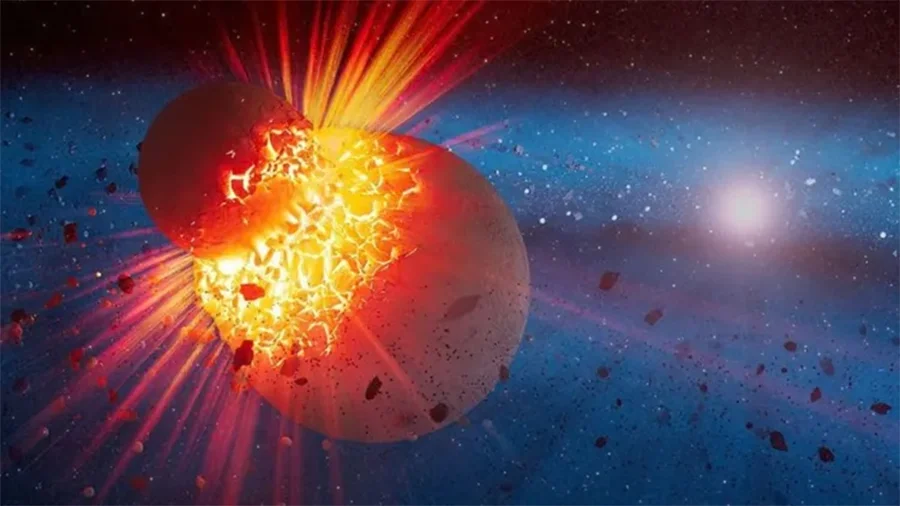
Billions of years ago, the early Solar System was a violent shooting gallery. Protoplanets the size of Mars and Mercury regularly collided in catastrophic impacts, reshaping crusts and determining orbital destinies. The most consequential of these events occurred when a Mars-sized protoplanet named Theia slammed into proto-Earth, expelling a gigantic ring of molten debris that rapidly coalesced to form the Moon.
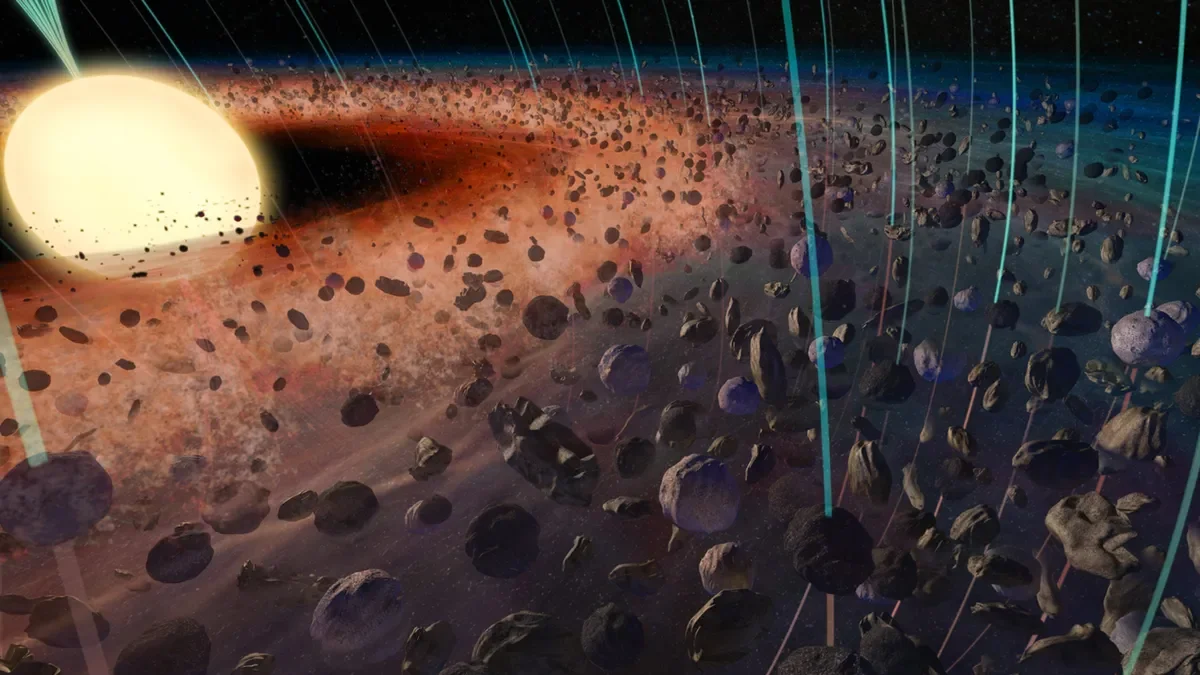
Now, NASA’s James Webb Space Telescope (JWST) is capturing this cosmic drama in real time across the galaxy. By peering into dusty debris disks around young stars, astronomers have directly observed massive plumes of vaporized silica, pulverized rock, and shattered planetesimals generated by high-velocity planetary impacts.
Detecting the Smoke of Planetary Destruction
Using its Mid-Infrared Instrument (MIRI), JWST turned its golden mirrors toward the nearby young star Beta Pictoris (located roughly 63 light-years away) and extreme debris systems around stars in the Scorpius-Centaurus association. Comparing JWST’s infrared spectra with archival data collected two decades ago by the Spitzer Space Telescope revealed dramatic changes.
Astronomers noticed that massive dust signatures previously detected around the stars had virtually vanished, while fresh plumes of ultra-fine carbonaceous and silicate grains had appeared elsewhere in the disk. The data indicates that approximately 20 years ago, two massive asteroids or protoplanetary bodies—each spanning hundreds of kilometers—collided at orbital velocities exceeding 30,000 km/h, pulverizing rock into microscopic dust grains that are now being pushed outward by stellar radiation pressure.
Validating the Giant Impact Hypothesis
These real-time observations provide the first observational confirmation that colossal protoplanetary collisions occur frequently during the first few tens of millions of years of a star’s life. Planetary geophysicists have long debated the exact mechanics of the Moon-forming Theia impact: Did the bodies strike head-on, or did they execute a glancing blow? Did Theia fully mix with Earth’s molten mantle?
By analyzing the grain sizes, mineral crystalline states, and cooling rates in alien collision plumes, researchers can directly validate hydrodynamic impact simulations. As humanity prepares to establish lunar settlements and studies what would happen if a doomsday asteroid hit the Moon today, JWST proves that the violent birth of our celestial companion was an inevitable chapter in the universal story of Earth’s formation and deep geological history.