At the center of our Solar System sits the Sun—a colossal thermonuclear furnace whose core fuses 600 million tons of hydrogen every second, radiating immense torrents of electromagnetic energy into space. Here on Earth, 150 million kilometers away, sunlight warms our oceans, fuels photosynthesis, and maintains a comfortable planetary average temperature of about 15 degrees Celsius (59°F).
Yet, the vast interplanetary space through which this solar radiation travels does not warm up at all. In the shade of deep space, temperatures plunge to a bone-chilling 2.7 Kelvin—barely 3 degrees above absolute zero (minus 270°C or minus 455°F). How can a heat source as ferocious as the Sun warm our planet without warming the space in between?
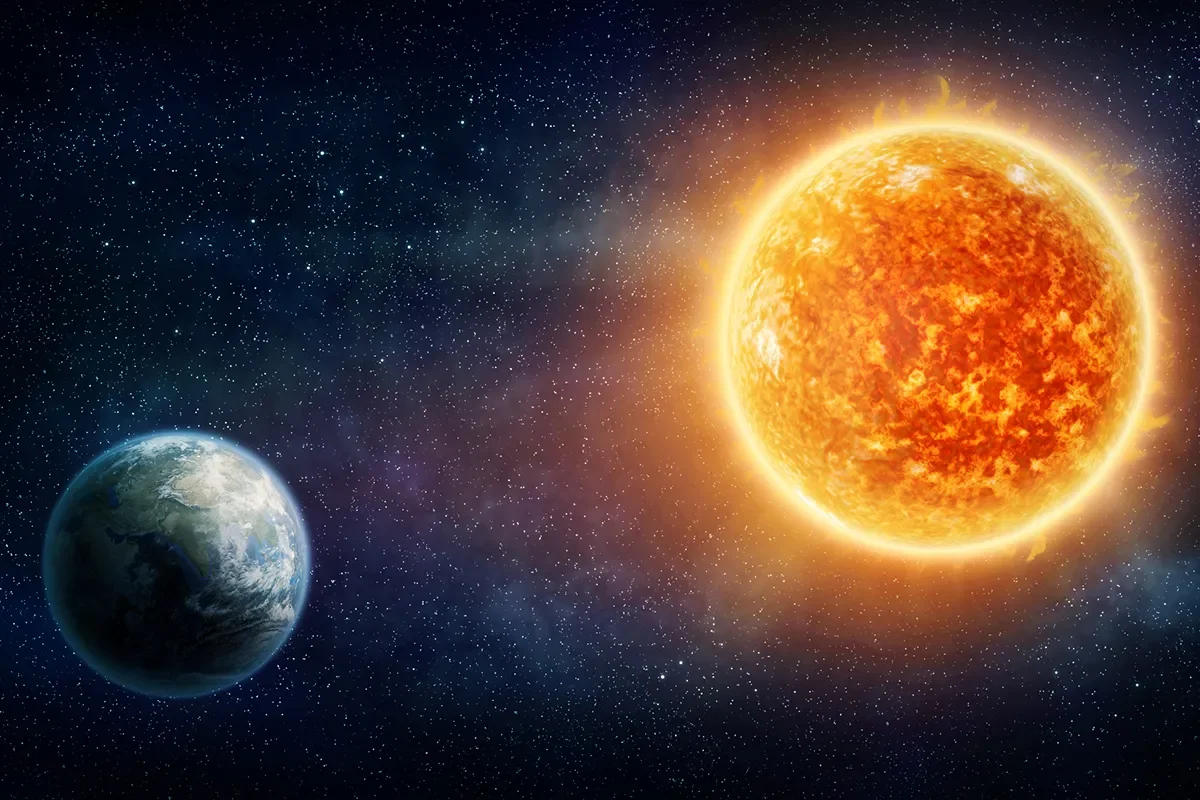
Heat Requires Matter: The Difference Between Heat and Radiation
The resolution to this apparent paradox lies in the fundamental physics of heat transfer. In everyday language, we often conflate “heat” with “radiation,” but in thermodynamics, they are fundamentally different concepts:
- Radiation: Energy traveling through space in the form of electromagnetic waves (such as sunlight, infrared, and ultraviolet rays). Radiation does not require a physical medium to propagate; it moves effortlessly through a vacuum.
- Heat: The kinetic energy of vibrating atoms and molecules within matter. A substance feels “hot” when its constituent particles are moving and colliding rapidly.
- Temperature: The measurement of the average kinetic energy of those particles.
Outer space is an almost perfect vacuum, containing fewer than a handful of hydrogen atoms per cubic meter. Because there are virtually no atoms to absorb photons and vibrate, there is essentially no “matter” to possess a temperature. Space is not cold because it actively absorbs heat; space is cold because it is virtually empty.
How Earth Traps Solar Energy
When solar radiation reaches Earth, it collides with a dense, atmospheric shield containing trillions of molecules of nitrogen, oxygen, water vapor, and carbon dioxide. The atmosphere, soil, and oceans absorb the incoming high-energy ultraviolet and visible light and re-emit it as longer-wavelength infrared radiation.
Greenhouse gases absorb this infrared energy, vibrating rapidly and trapping heat within the lower atmosphere—the natural greenhouse effect that makes life possible. Without this atmospheric blanket, Earth’s surface temperature would average a hostile minus 18°C (0°F).
Understanding the interplay between thermal radiation, vacuum thermodynamics, and atmospheric retention is vital for everything from designing spacecraft thermal blankets to forecasting the distant future when Earth will be swallowed or torn apart by the Sun as our star expands. The cosmos reminds us that sunlight is merely potential energy until it touches a world with the substance to catch it.