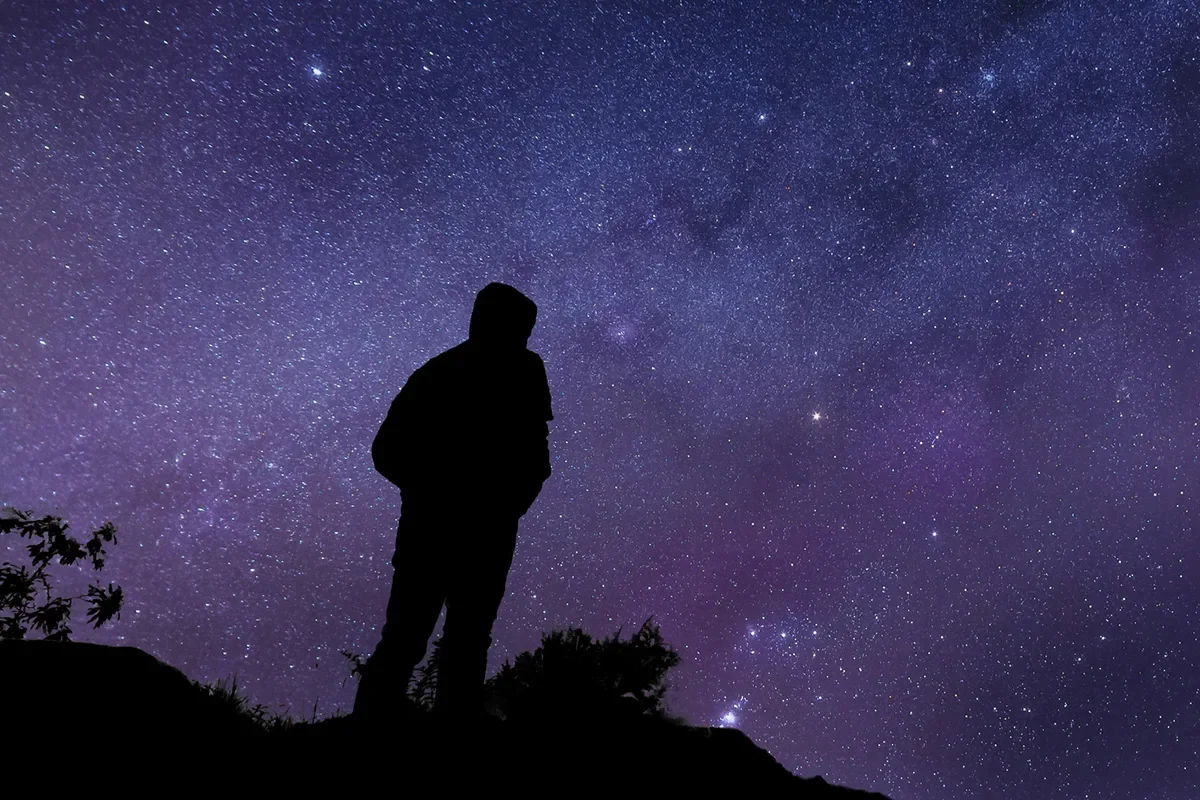
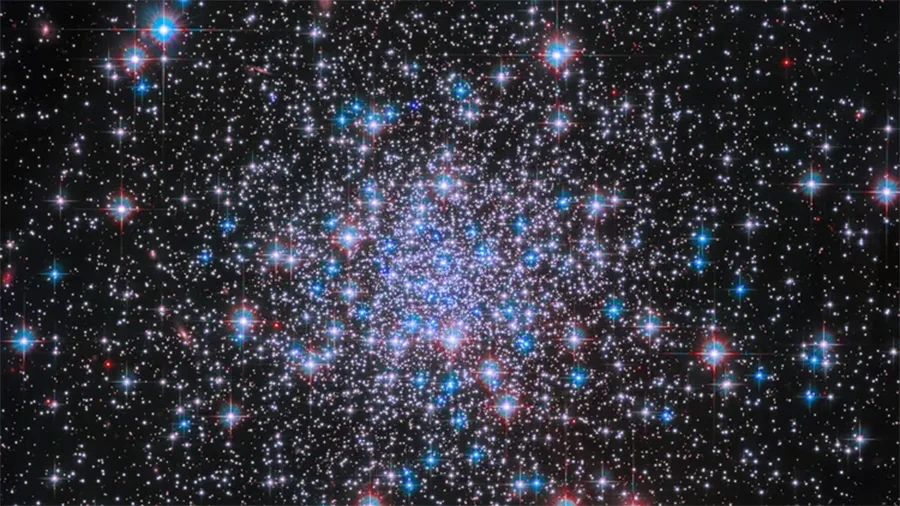
It is one of the most intuitive yet profound questions in all of natural philosophy: If the universe is infinitely large and packed with hundreds of billions of galaxies containing trillions upon trillions of luminous stars, why is the night sky dark? In a truly infinite, static cosmos populated uniformly with stars, every single line of sight from Earth should eventually terminate on the surface of a star. As a result, the entire nocturnal vault should blaze with the blinding brightness of the Sun’s surface.
First popularized by German astronomer Heinrich Wilhelm Olbers in 1823, this conceptual puzzle—known as Olbers’ Paradox—stumped philosophers and scientists for centuries. Its modern resolution provides definitive observational proof that our universe had a beginning and is actively expanding through space and time.
The Dual Solution: Finite Cosmic Age and the Speed of Light
The primary reason the night sky is dark stems from the fact that the universe is not infinitely old. Modern cosmological measurements, anchored by observations of the Cosmic Microwave Background (CMB) from the Planck satellite, establish the age of the universe at approximately 13.8 billion years.
Because light travels at a finite velocity (approximately 300,000 kilometers per second), we can only see light that has had enough time to reach us since the Big Bang. This establishes an observational boundary called the cosmological horizon, enclosing the “observable universe.” Beyond this horizon, light from trillions of more distant stars and proto-galaxies simply hasn’t had sufficient time to arrive at our eyes.
Cosmic Expansion and the Redshift of Light
The second pillar solving Olbers’ Paradox is the expansion of space itself. In 1929, Edwin Hubble demonstrated that distant galaxies are receding from Earth in all directions. As space expands, the wavelengths of photons traveling across billions of light-years are physically stretched—a phenomenon known as cosmological redshift.
Light emitted by early stars as brilliant visible and ultraviolet radiation has been stretched into infrared wavelengths and microwaves, rendering it completely invisible to human eyes without specialized astronomical sensors. The ancient Big Bang fireball itself has cooled into the pervasive 2.7 Kelvin microwave background.
Understanding how light, distance, and cosmic geometry interact not only solves classical paradoxes, but also sharpens our ability to detect faint, hidden structures in our own cosmic backyard, such as the ongoing hunt for an enigmatic hidden world at the Solar System’s outer edge. The darkness of night is not an absence of light; it is the silent testimony of a young, dynamically expanding universe.