For decades, the search for extraterrestrial intelligence (SETI) has concentrated almost exclusively on listening for fleeting radio signals or scanning distant star systems for laser pulses. However, a growing cohort of astrophysicists and planetary scientists, including researchers from Harvard University and Arizona State University, is championing an alternative, physical strategy: searching for alien artifacts right in our cosmic backyard—on the surface of the Moon.
Because the Moon is an airless, geologically inactive body without wind, rain, volcanic recycling, or plate tectonics, its surface acts as an immutable cosmic archive. Any technological probe, discard, or micro-machinery that crashed or was deliberately deposited on the Moon billions of years ago could remain preserved almost indefinitely beneath the pulverized regolith.
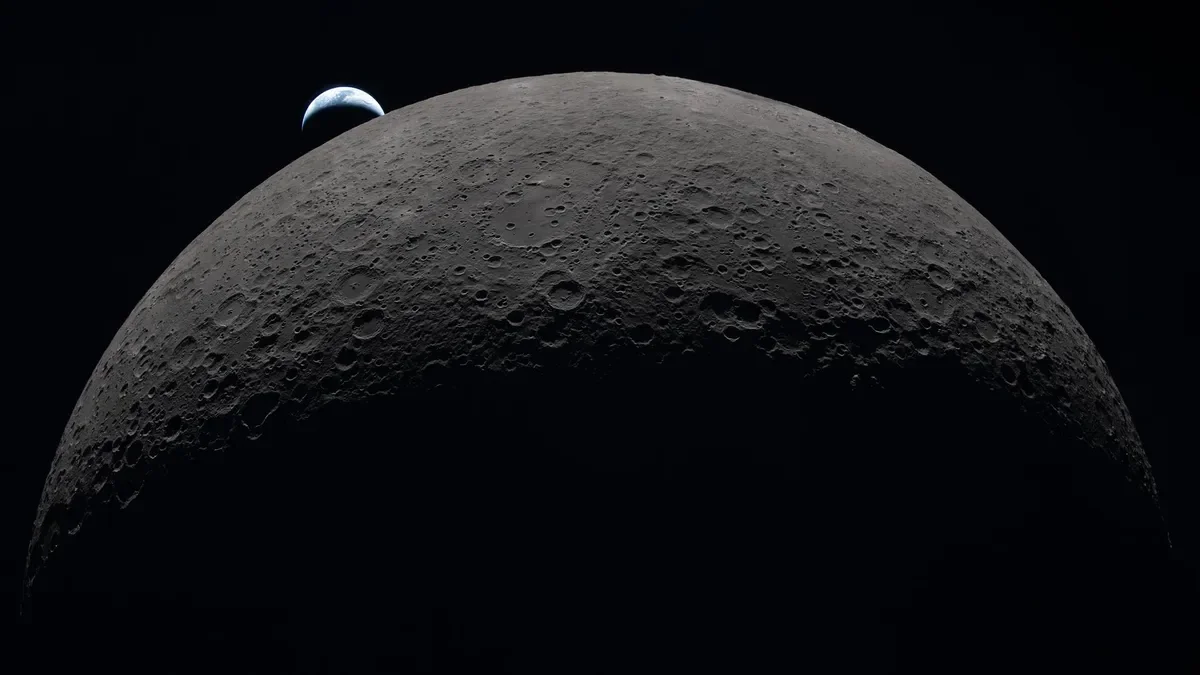
The Moon as an Ideal Cosmic Archeological Site
On Earth, the physical remnants of ancient civilizations vanish rapidly. Wind and rain erode stone monuments, rivers bury cities in silt, and relentless plate tectonics subducts entire continental plates into the mantle every few hundred million years. On Earth, finding a machine or artifact left behind two billion years ago is geophysically impossible.
The Moon, by contrast, changes only under the slow, steady churn of micrometeorite bombardment (“gardening”), which overturns the top few centimeters of lunar dust over millions of years. Deep within permanently shadowed craters at the lunar poles, temperatures plummet to near absolute zero, creating cryogenic time capsules where even delicate synthetic polymers, specialized alloys, or microelectronic architectures could survive without chemical degradation for billions of years.
What Would a Lunar Technosignature Look Like?
Scientists scouring lunar orbital imagery from missions like NASA’s Lunar Reconnaissance Orbiter (LRO) look for specific physical anomalies: non-natural geometric shapes, unusual metallic spectral signatures, localized isotopic imbalances (such as artificial nuclear fission products), or unnatural radioactive decay chains.
If an advanced extraterrestrial civilization visited the Solar System hundreds of millions of years ago, automated reconnaissance probes could have observed primitive Earth from lunar orbit, just as humanity now observes other planets. As researchers assess the risks of lunar exploration—from cosmic radiation to what would occur if a doomsday asteroid struck the Moon—lunar surface exploration is expanding beyond resource extraction into the most exciting archaeological frontier in human history.