Look up at the Moon tonight, and you are gazing upon the exact same craters, mountains, and basaltic plains that captivated the gaze of ancient hominids millions of years ago. Whether viewed from Tokyo, Paris, or New York, the Moon presents the exact same lunar face toward our planet. The mysterious “far side” of the Moon was completely hidden from human eyes until the Soviet Luna 3 probe snapped the first grainy photographs in October 1959.
A common misconception is that the Moon does not rotate at all. In reality, the Moon rotates steadily on its axis, but it does so in the exact same amount of time it takes to complete one revolution around Earth: 27.3 days. This perfect gravitational synchronization is known in orbital mechanics as 1:1 spin-orbit resonance, or tidal locking.

How Gravity Slowed the Moon’s Spin
When the Moon formed approximately 4.5 billion years ago following a colossal impact between proto-Earth and a Mars-sized planet, it was much closer to Earth and spun rapidly, completing a full rotation in just a few hours. Because gravity weakens with distance, Earth’s powerful gravitational pull exerted a stronger tug on the near side of the young, molten Moon than on its far side.
This differential pull stretched the Moon into a subtle, football-like oblate shape, raising distinct tidal bulges of rock. As the Moon rotated faster than its orbital speed, these rocky bulges were dragged slightly ahead of the Earth-Moon orbital axis. Earth’s gravity immediately pulled back on this misaligned bulge, creating an immense gravitational braking torque. Over tens of millions of years, this tidal friction inexorably bled off the Moon’s rotational energy until its spin period matched its orbital period exactly, locking the bulge in permanent alignment toward Earth.
Libration: Peeking Around the Edge
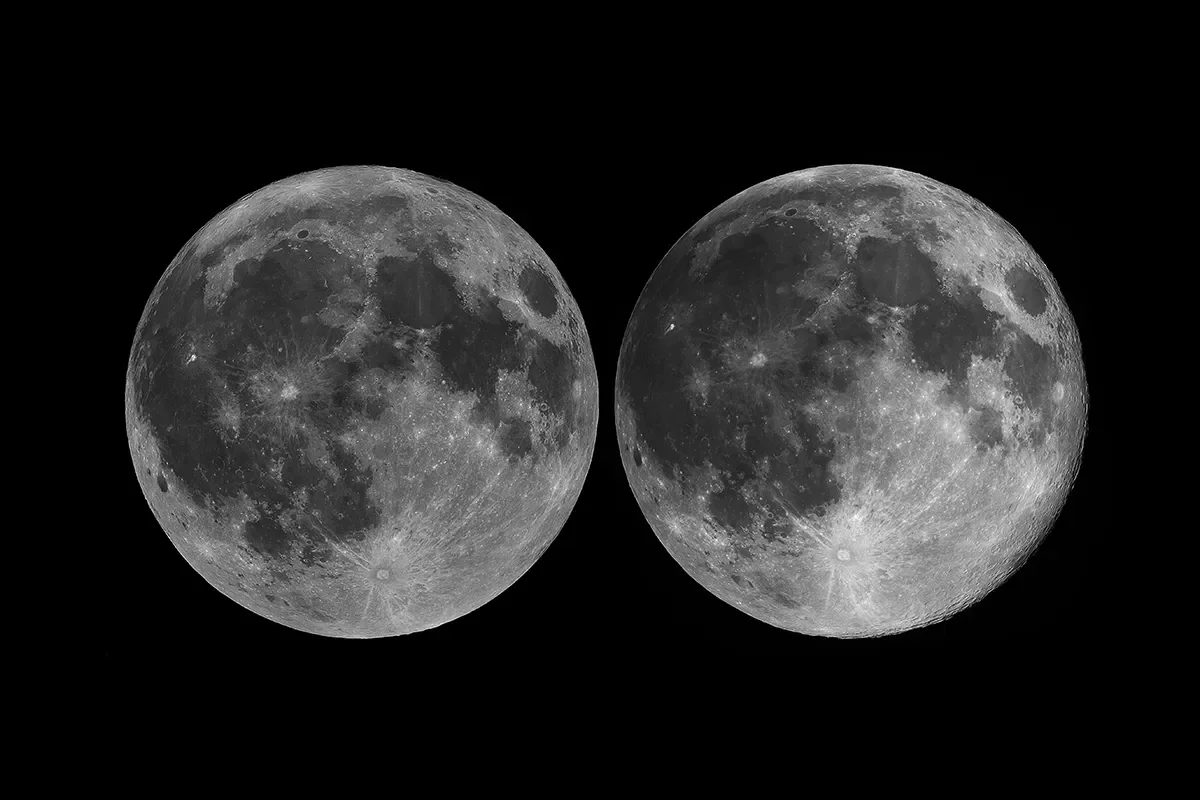
While the Moon is tidally locked, we actually get to see slightly more than half of its surface over time—about 59% in total. This phenomenon is called lunar libration. Because the Moon’s orbit around Earth is elliptical rather than circular (Kepler’s First Law), its orbital velocity speeds up when it is closer to Earth (perigee) and slows down when it is farther away (apogee).
However, the Moon’s rotational speed remains constant. This subtle mismatch causes the Moon to appear to nod slowly up and down and sway from side to side like a gentle pendulum, allowing astronomers on Earth to periodically peek around its eastern and western limbs.
Tidal locking is not unique to the Moon; it is a universal outcome of orbital evolution. Most major moons in our Solar System are tidally locked to their parent planets, and millions of close-in rocky exoplanets are permanently locked to their stars. Studying these celestial mechanics enriches our broader understanding of Earth’s formation and deep geological history, demonstrating how gravity sculpts the architecture of worlds.