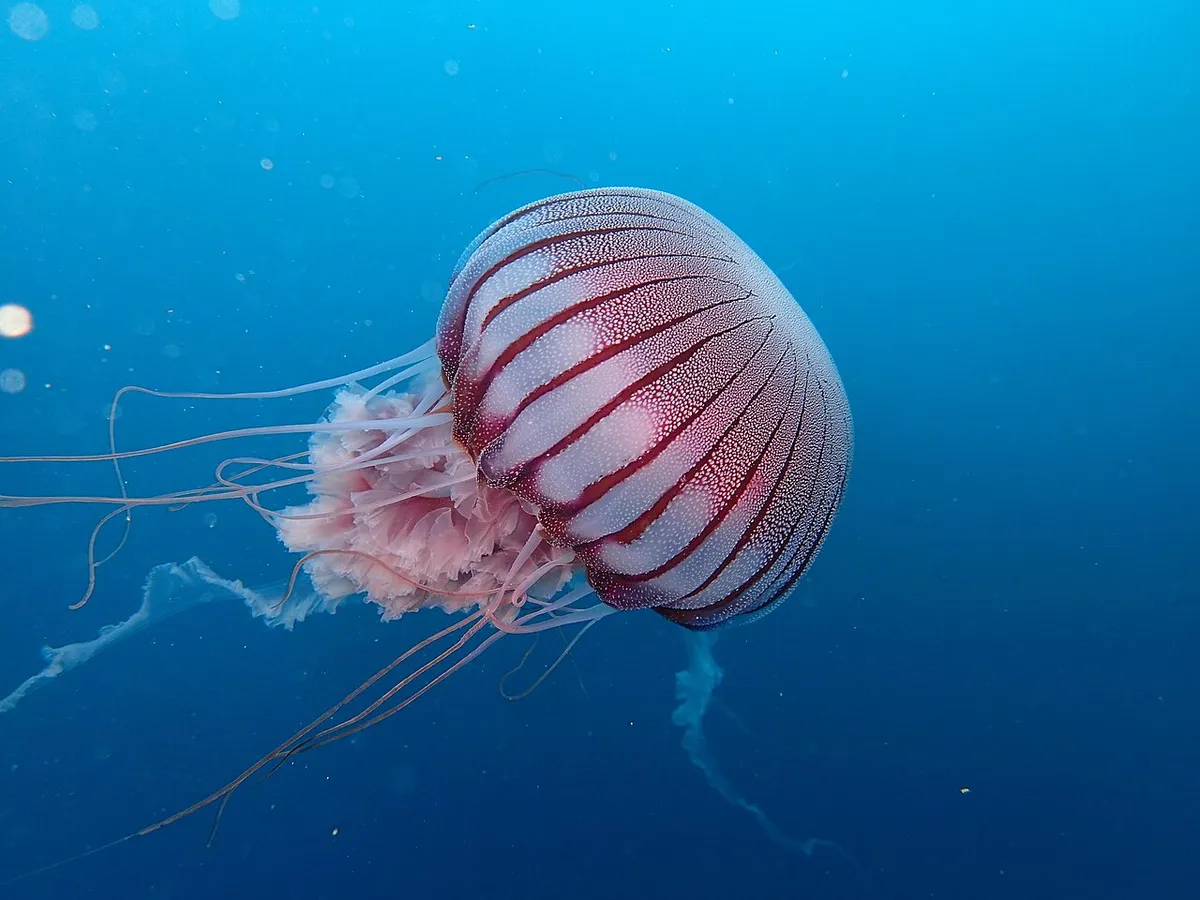
Beneath the sunlit surface lies Earth’s largest and least explored habitat. Test what you know about abyssal creatures, and see the largest fish species in the ocean.
Question 1 of 10
Roughly how deep does sunlight penetrate into clear ocean water before photosynthesis becomes impossible?
The epipelagic or sunlight zone extends down to about 200 meters (656 feet); below that lies the dim twilight zone.
Question 2 of 10
What chemical process do bacteria around deep-sea hydrothermal vents use to make food without sunlight?
Chemosynthesis uses energy from chemical reactions involving hydrogen sulfide or methane instead of sunlight.
Question 3 of 10
Most deep-sea animals produce their own light through bioluminescence.
True. According to NOAA, roughly three-quarters of midwater deep-sea organisms create light to hunt, communicate, or evade predators.
Question 4 of 10
Which deep-sea cephalopod has the largest eyes of any known animal on Earth?
The colossal squid has eyes up to 10–11 inches (27 cm) wide—about the size of a dinner plate—to spot predators in dim depths.
Question 5 of 10
Water at the bottom of the Mariana Trench freezes solid due to extreme depth.
Myth. Despite near-freezing temperatures of 1–4°C, immense pressure and salt content keep deep ocean water liquid.
Question 6 of 10
How do female deep-sea anglerfish attract prey in pitch-black water?
A modified dorsal fin spine called an esca houses bioluminescent bacteria that glow like a fishing lure.
Question 7 of 10
Which region of the ocean is known as the ‘midnight zone’ where zero sunlight reaches?
The bathypelagic (midnight) zone spans from 1,000 to 4,000 meters deep and is completely dark except for bioluminescence.
Question 8 of 10
What is ‘marine snow’ in the deep ocean?
Marine snow is a continuous shower of dead plankton, fecal pellets, and organic detritus drifting down to feed deep-sea life.
Question 9 of 10
Deep-sea hydrothermal vents can release superheated water exceeding 350°C without boiling.
True. Crushing hydrostatic pressure at the seafloor prevents superheated vent water from turning into steam.
Question 10 of 10
Which deep-diving whale is capable of holding its breath for over two hours to hunt squid?
Cuvier’s beaked whales hold the mammalian diving record, reaching depths near 3,000 meters and staying down over 2 hours.
Want to compare ocean giants with river monsters? Explore the largest freshwater fish species in the world.