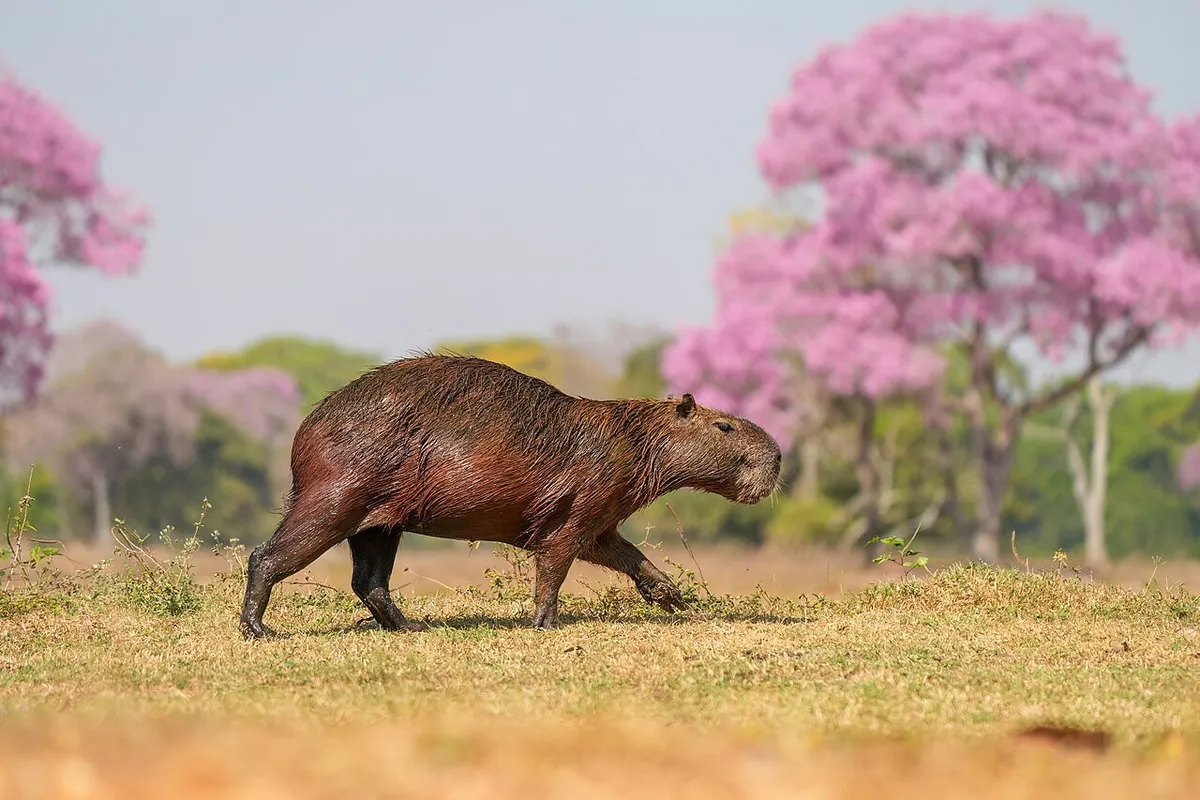
Rodents make up roughly 40% of all mammal species, ranging from tiny harvest mice to ecosystem-shaping beavers. Test your rodent trivia, and read about a cat and capybara friendship.
Question 1 of 10
What defining trait do all true rodents share—from mice to porcupines?
Every rodent has a single pair of upper and lower rootless incisors that grow nonstop and stay sharp through gnawing.
Question 2 of 10
Which semi-aquatic South American mammal is the largest living rodent on Earth?
Adult capybaras can weigh over 140 pounds and have webbed toes for swimming.
Question 3 of 10
Porcupines can shoot their sharp quills across a room like arrows at attackers.
Myth. Porcupine quills detach easily upon direct contact, but porcupines cannot launch or throw them.
Question 4 of 10
Which burrowing African rodent lives in underground colonies like bees, feels almost no pain from acid, and can live over 30 years?
Naked mole-rats are eusocial mammals with a queen, remarkable cancer resistance, and extreme longevity.
Question 5 of 10
Why do beavers build dams across streams and rivers?
Deep ponds protect underwater entrances to beaver lodges from wolves and store submerged branches for winter food.
Question 6 of 10
Rabbits and hares are classified as rodents.
False. Rabbits, hares, and pikas belong to the order Lagomorpha, possessing a second tiny pair of upper peg teeth behind their main incisors.
Question 7 of 10
How do squirrels locate thousands of acorns and nuts they bury each autumn?
Tree squirrels build detailed mental maps of landmarks and use smell to sniff out buried caches under snow.
Question 8 of 10
Why are a beaver’s front teeth bright orange?
Iron incorporated into the outer enamel makes beaver incisors extra hard and resistant to acid and wear.
Question 9 of 10
Chinchillas have some of the densest fur of any land mammal—so thick that fleas struggle to survive in it.
True. Up to 60–80 hairs grow from a single follicle, keeping chinchillas warm in the high Andes.
Question 10 of 10
Which rodent is famous for storing food in expandable fur-lined cheek pouches that can double its head width?
Hamsters stuff seeds and grains into dry cheek pouches to carry safely back to underground burrows.
Curious about other small mammals? Read our article on mice and human ecosystems.