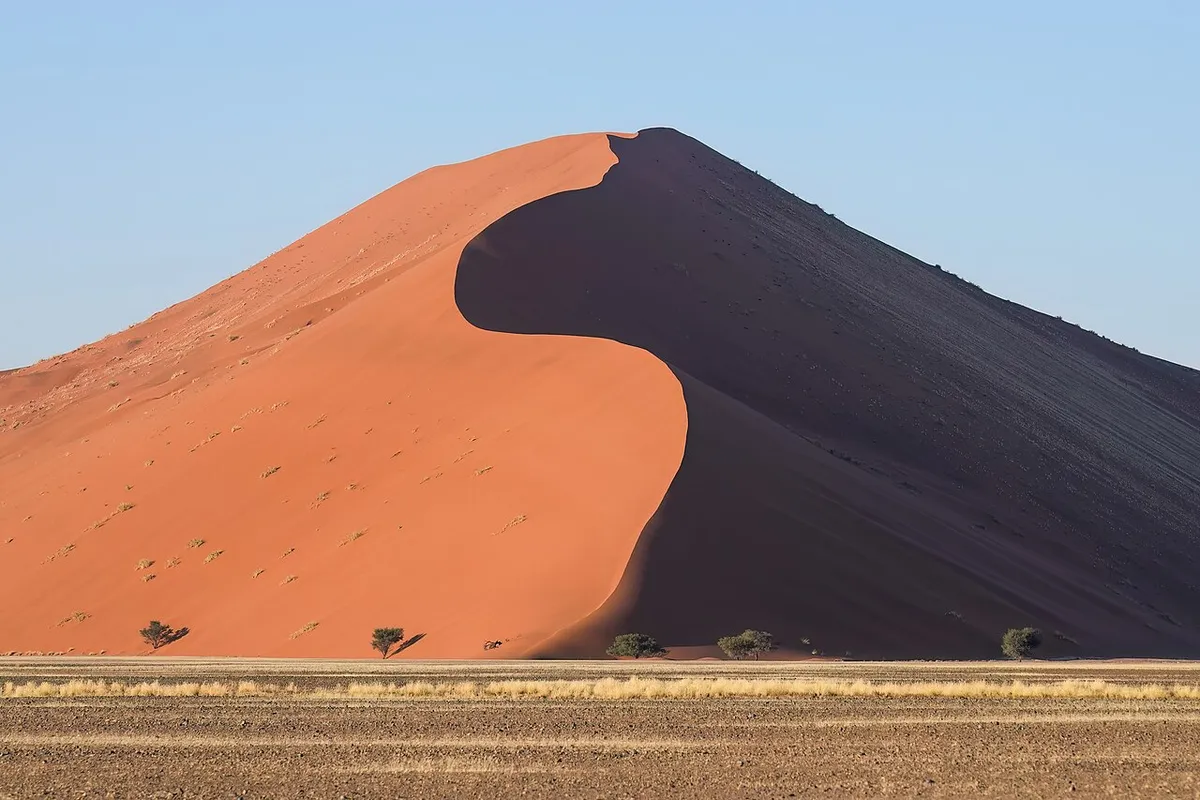
Deserts are defined by scarcity of rain, not just scorching sand—and some are freezing cold. Test your desert knowledge, and explore our Natural Wonders of the World Quiz.
Question 1 of 10
Which is the largest desert on Earth by total surface area?
Deserts are defined by low precipitation; Antarctica covers roughly 5.5 million square miles, making it Earth’s largest desert.
Question 2 of 10
Which desert in northern Chile is considered the driest non-polar desert on Earth?
Blocked by the Andes and cold ocean currents, parts of the Atacama Desert go years without measurable rainfall.
Question 3 of 10
Most of the Sahara Desert is covered in towering sand dunes.
Myth. Sand seas (ergs) cover only about 20–25% of the Sahara; the rest is gravel plains, rocky plateaus, and mountains.
Question 4 of 10
Why can hot deserts drop sharply in temperature—sometimes below freezing—after sunset?
Water vapor and clouds act like a blanket trapping daytime heat; dry desert skies allow rapid radiative cooling at night.
Question 5 of 10
Which desert animal survives almost its entire life without drinking liquid water, getting moisture from seeds?
Kangaroo rats extract metabolic water from dry seeds and conserve moisture with super-efficient kidneys.
Question 6 of 10
Camels store liquid water inside their humps for long journeys.
Myth. Camel humps store energy-rich fat, while specialized red blood cells and low water loss let them endure weeks without drinking.
Question 7 of 10
In which desert do fog-basking beetles stand head-down on coastal dunes to drink morning ocean mist?
Namib Desert darkling beetles capture tiny droplets from Atlantic coastal fog on their bumpy wing covers.
Question 8 of 10
The Gobi Desert in Mongolia and China can experience winter temperatures well below -30°C.
True. Located far inland at high elevation and latitude, the Gobi is a cold-winter desert that even gets occasional snow.
Question 9 of 10
Which iconic cactus of the Sonoran Desert can live over 150 years and grow taller than 40 feet?
Saguaro cacti expand like accordions during rare desert rains and provide nesting cavities for desert birds.
Question 10 of 10
All deserts on Earth receive zero rainfall every single year.
False. Deserts are generally defined as receiving less than 10 inches (250 mm) of precipitation annually, often in brief bursts.
Curious how Earth compares with dry alien worlds? Read why Earth thrives while Mars became a frigid desert.