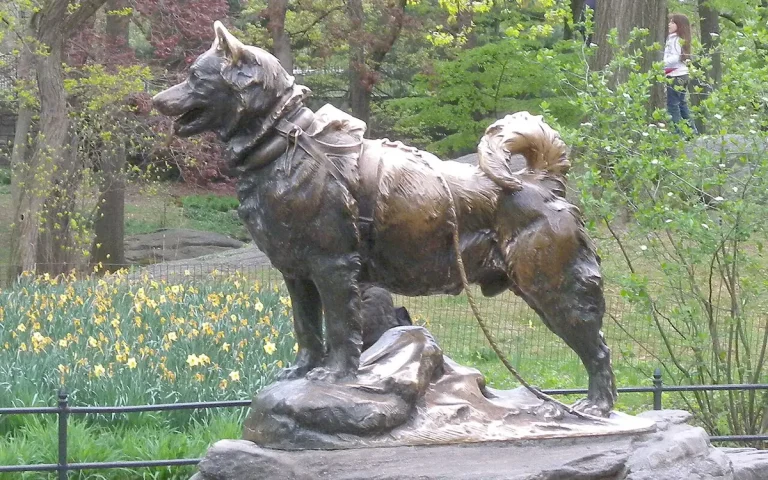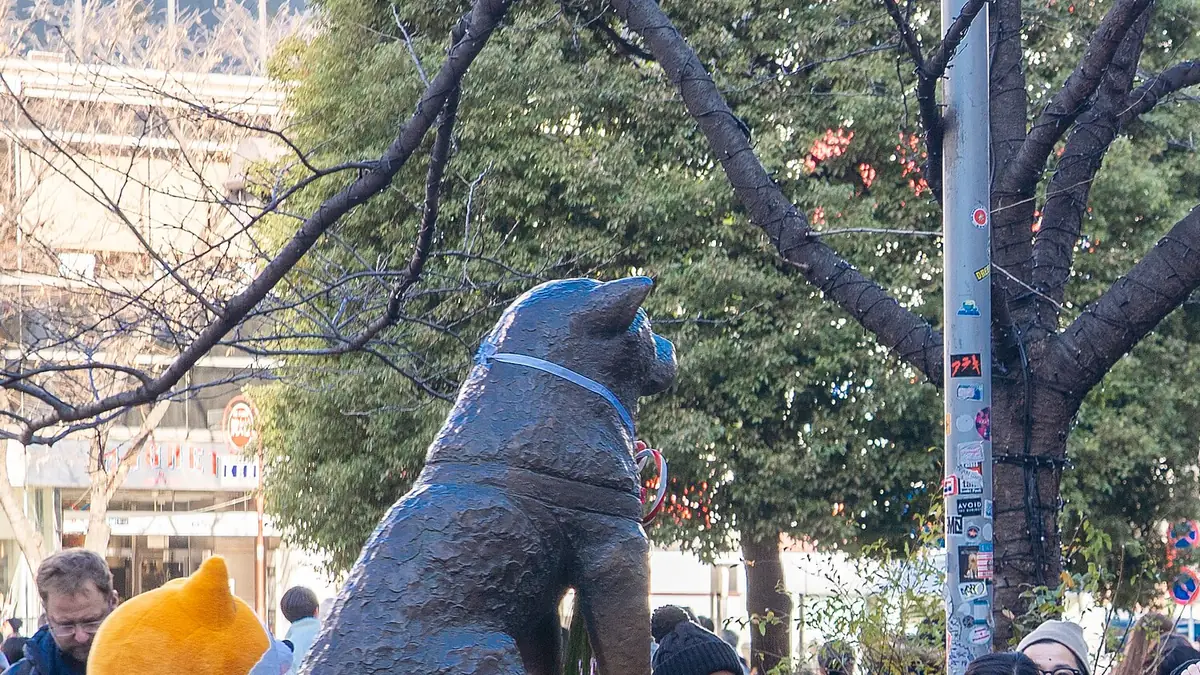
Just after 6 a.m. on March 8, 1935, Haruno Takizawa found a large white dog lying at the mouth of an alley in Shibuya, a few steps north of the Takizawa liquor store. The body was still warm. The dog was Hachikō, and by then a bronze statue of him already stood at nearby Shibuya Station.
Hachikō was an Akita, one of the most beautiful dog breeds in the world. For nine years and nine months after his owner died, he kept going back to the station. This is what the records say about him, where the popular version drifts from them, and why some researchers still question the legend.
At a glance
- Who
- Hachikō, a white Akita dog
- Owner
- Hidesaburō Ueno, agriculture professor
- Where
- Shibuya Station, Tokyo, Japan
- When
- 1923 to 1935
- Known for
- Returning to the station for almost ten years after Ueno died in 1925
A puppy carried through a blizzard
Hachikō was born in mid-November 1923 on a farm in Ōdate, in Akita Prefecture in northern Japan. He was one of four male puppies. The exact day was never written down: Japan usually celebrates November 10, while a birth certificate produced in 1934 says November 20.
In Tokyo, an agriculture professor named Hidesaburō Ueno wanted an Akita. A former student, Chiyomatsu Mase, found him one. Many retellings say Ueno paid 30 yen, but the most detailed research describes the puppy as a gift. Mase’s employee Reizō Kurita and his companions walked about 20 kilometers through a blizzard to put the dog on a train.
Hachikō left Ōdate on January 14, 1924, packed in a straw bag. He reached Ueno Station in Tokyo the next day. He was so weak that the household first thought he would not survive, and Ueno and his partner, Yaeko Sakano, spent about six months nursing him back to health.
The professor and his dog
Ueno taught at Tokyo Imperial University, now the University of Tokyo, and was one of the pioneers of agricultural engineering in Japan. He lived in Shibuya with Yaeko, their adopted daughter Tsuruko and several dogs.
The version most people know goes like this: every morning Hachikō walked Ueno to Shibuya Station, and every evening he came back to meet the train. Historians at the University of Tokyo tell it a little differently. Ueno’s house stood in the Shōtō neighborhood, between Shibuya Station and the university’s Komaba campus, and he usually walked to work. According to that research, Hachikō saw him off and often waited near the gate of the Faculty of Agriculture.
Both versions agree on one point. The walk through Shibuya was their daily ritual.
May 21, 1925
On May 21, 1925, Ueno collapsed at the university and died of a sudden stroke. Popular accounts place it in the middle of a lecture; the more detailed record says it happened in a colleague’s office after a faculty meeting. He never came home.
The next day Hachikō disappeared. He was found on May 24 in a storage shed, curled on a futon where Yaeko had put the shirt Ueno was wearing when he died. He had not eaten. During the wake he lay under his owner’s coffin, and on May 26 he was back at Shibuya Station.
A dog without a home
Ueno’s household broke up within weeks. In early July 1925 Yaeko moved to a rented house, and Hachikō was sent away. He stayed briefly at a relative’s kimono shop. Then he went to Yaeko’s sister and her husband in Asakusa, where he was kept tied up.
That did not last. Later that summer Yaeko handed him to Kikusaburō Kobayashi, the family’s gardener, whose house was about a 20-minute walk from Shibuya Station. The Kobayashis kept him for the rest of his life (accounts disagree on how many months he spent in Asakusa before the move).
Nine years at Shibuya Station
From the Kobayashi home, Hachikō set out each morning at around 9 a.m. and came back between 5 and 6 p.m. Much of the day he spent at the station. By 1933 the Kobayashis had built him a wooden bed lined with straw so he had somewhere to lie.
The station was not always kind to him. Passengers kicked and pushed him. Yakitori vendors poured water on him to drive him away, station staff once painted his face with ink, and his collar and name tag were stolen more than once. Dogcatchers picked him up at least once, and a policeman brought him back to Kobayashi.
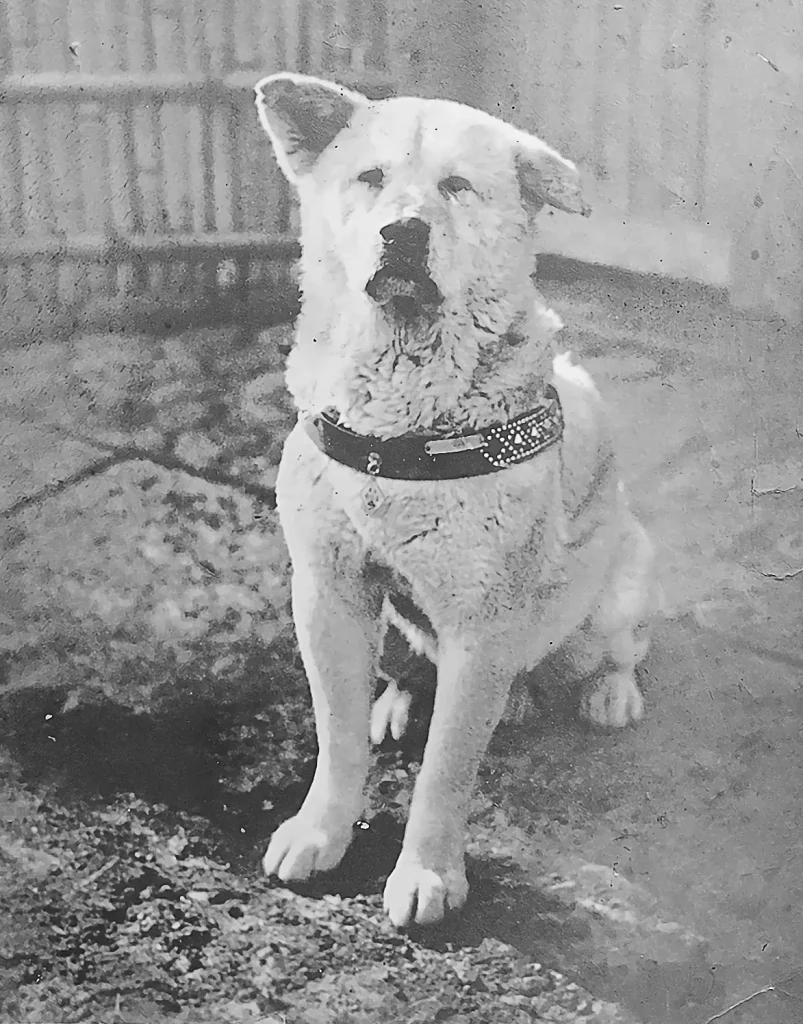
Some people looked after him. Vendors and commuters fed him scraps, and in January 1934 fourth-grade pupils from Uguisudani Elementary School wrote to stationmaster Tadaichi Yoshikawa asking that the dog be protected from the kicking. By then Hachikō was famous.
How a newspaper made him famous
The man behind that fame was Hirokichi Saitō, who was trained in fine art and had founded the Society for the Preservation of Japanese Dogs in May 1928. He first saw Hachikō in July 1928. Saitō was surveying native breeds, and he counted only about 30 purebred Akitas left in Japan. Hachikō was one of them.
Saitō passed material about the dog to the Tokyo Asahi Shimbun. On October 4, 1932, the paper ran a story under the headline “Tale of a Poor Old Dog: Patiently Waiting for Seven Years for the Dead Owner.” Saitō had not been told it would be published, and it contained errors that he corrected a month later. It did not matter. People began adding “-kō”, an affectionate honorific, to the dog’s name, and Hachikō was invited to the first Japanese dog show on November 6, 1932. In 1934 a school ethics textbook used his story to teach children gratitude.
A statue for a living dog
Sculptor Teru Andō began planning a statue in 1933, and a public fundraising drive started on January 1, 1934. At 1 p.m. on April 21, 1934, the bronze was unveiled in front of Shibuya Station. Hachikō was there. Ueno’s ten-year-old granddaughter, Hisako, cut the ribbon.
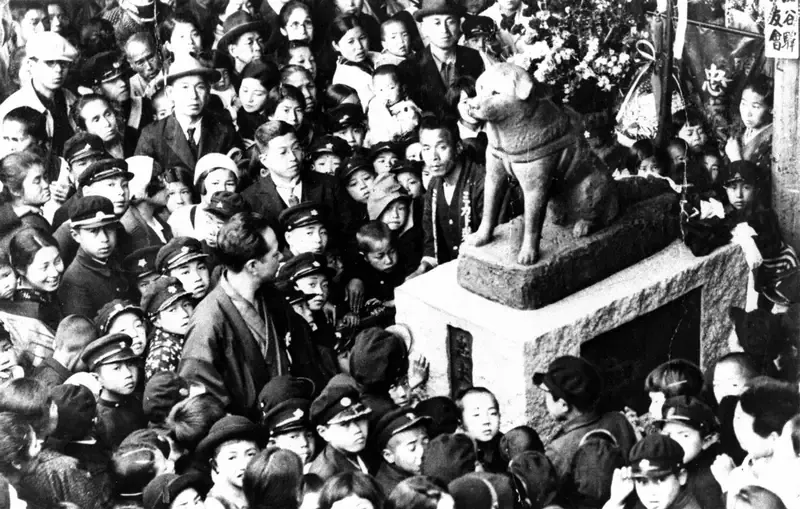
That first statue did not survive the war. It was taken down in October 1944 for the metal drive and melted in August 1945. Teru Andō was killed in an air raid that May. In 1948 his son, Takeshi Andō, made a new statue, unveiled on August 15 of that year; it is the one that stands outside the Hachikō Exit today. Takeshi Andō later said: “It is proof that he is loved and touched by everybody.”
The last morning
About three months before his death, Hachikō stopped making the daily trip. He died on March 8, 1935, at the age of 11. A necropsy that afternoon found heartworm, and four yakitori skewers in his stomach. The skewers had not injured him, but the rumor that they killed him lasted for decades.
In 2011 researchers at the University of Tokyo examined his preserved organs again. They found more than 30 heartworms in his heart and signs of terminal cancer in his heart and lungs. “Hachiko seemed to have carcinosarcoma,” said Kazuyuki Uchida of the University of Tokyo.
Where you can see Hachikō today
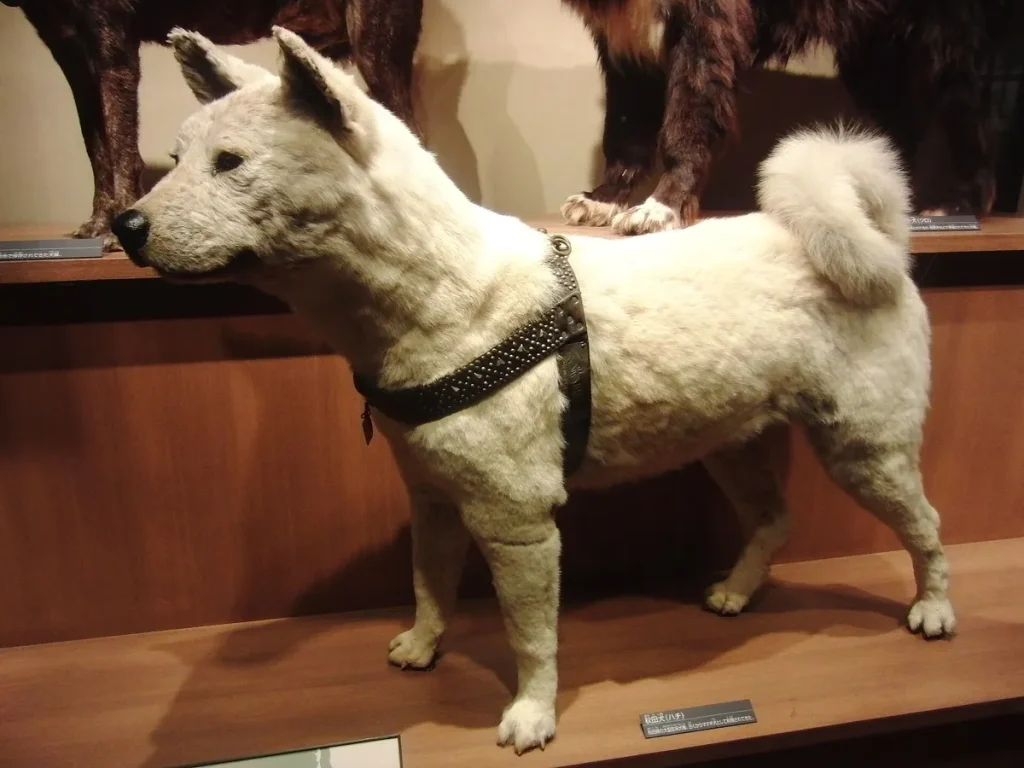
After his death Hachikō’s pelt was mounted, a job that took three months. It is on display at the National Museum of Nature and Science in Ueno Park, Tokyo. Look closely and you will notice both ears stand upright; the statue shows his left ear drooping.
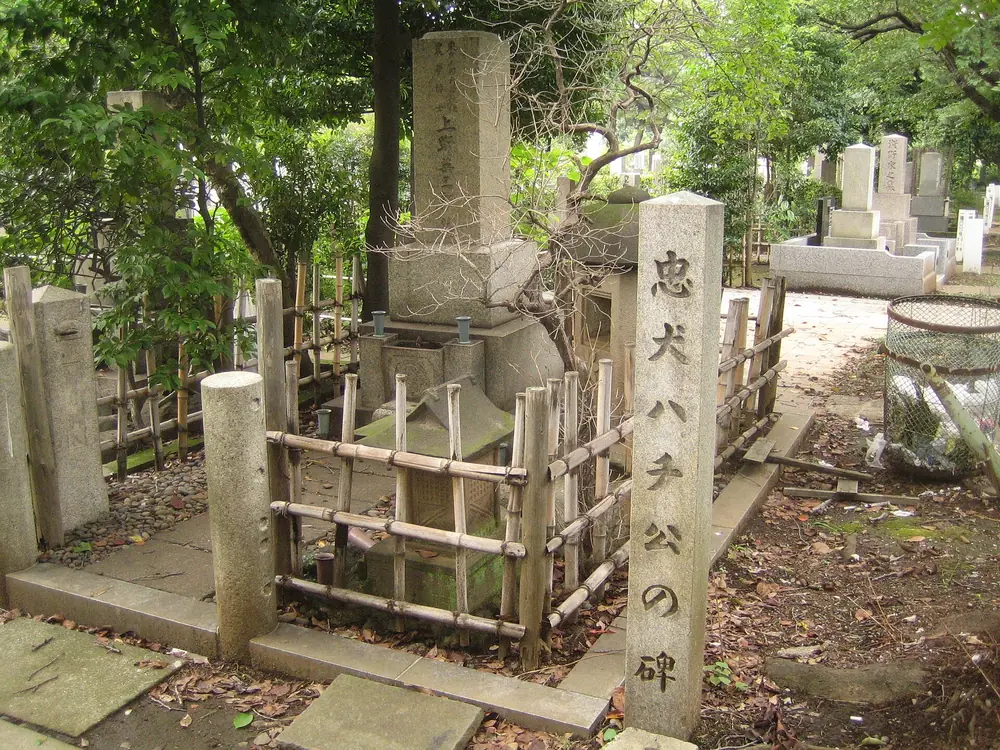
His internal organs are kept in formalin at the University of Tokyo’s Yayoi campus. Part of his remains rests beside Ueno at Aoyama Cemetery (some sources say his ashes, others only his cremated organs). In 2016, part of Yaeko Sakano’s remains was buried at the same grave, so the dog now lies with both of the people who raised him.
The University of Tokyo added its own statue in 2015, for the 80th anniversary of his death. Made by sculptor Tsutomu Ueda, it shows Hachikō leaping up to greet Ueno, the reunion the dog never had.
Was Hachikō really waiting?
Not everyone accepts the legend. Mizoguchi, a researcher quoted in a 2024 University of Tokyo feature, put it plainly: “For me, it didn’t ring true that a dog would wait for its master at the station every day.” One theory holds that Hachikō came for the yakitori stalls around the station. Critics of that theory point out that the stalls opened in the evening, while Hachikō arrived each morning too.
How much a dog understands about loss is hard to measure, and scientists still argue over what goes on in the minds of even the smartest animals on Earth. Endo, quoted by The Japan Times, offered a gentler reading: “Hachiko lived a better life in Shibuya with good care from people in the restaurant area.” Both versions leave the same facts in place: the dog kept coming back for almost ten years.
The story has been filmed three times: the Japanese film Hachikō Monogatari in 1987, the American Hachi: A Dog’s Tale with Richard Gere in 2009, and a Chinese version. Every year on March 8, people still gather at the statue outside Shibuya Station to remember him.
Test yourself: Hachikō quiz
Question 1 of 5
Where was Hachikō born?
Ōdate, Akita Prefecture. He was born on a farm there in November 1923 and arrived in Tokyo in January 1924.
Question 2 of 5
What did Hidesaburō Ueno do for a living?
He was an agriculture professor at Tokyo Imperial University and one of the pioneers of agricultural engineering in Japan.
Question 3 of 5
In which year did Ueno die?
1925. Ueno died on May 21, 1925, when Hachikō was about 18 months old.
Question 4 of 5
What happened to the first Hachikō statue, unveiled in 1934?
It was melted down during World War II. A new statue by Takeshi Andō replaced it in 1948.
Question 5 of 5
What did the 2011 re-examination of Hachikō’s organs find?
He had heartworm and terminal cancer. The skewers found in his stomach had not harmed him.
Sources
- Hachikō, Wikipedia
- Hachiko feature, part 2, The University of Tokyo, September 2024
- The True Story of Hachiko, the Most Loyal Dog in History, Mary Austin, AOL, July 2025
- The True Story of the World’s Most Loyal Dog, Hachiko, Mikael Angelo Francisco, Grunge, March 2022
Featured image: statue of Hachikō at Shibuya Station. Photo: Dick Thomas Johnson, CC BY 2.0, via Wikimedia Commons (cropped).