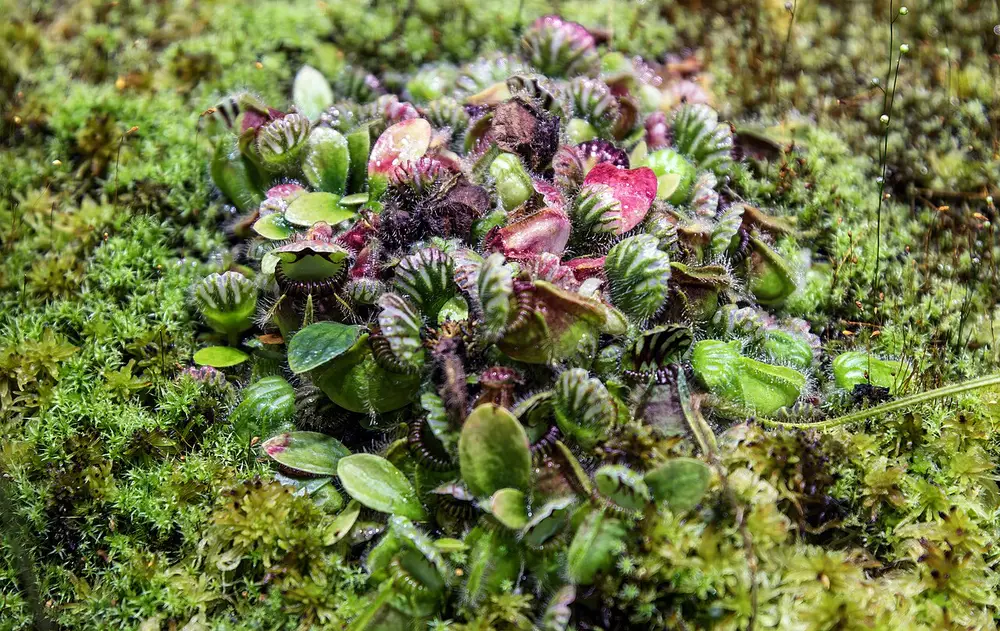
Some plants survive nutrient-poor bogs by trapping insects, while others mimic rotting meat or fold at a touch. Test your botanical trivia, and check out our Plants & Trees quiz.
Question 1 of 10
Why do carnivorous plants like Venus flytraps and sundews eat insects?
Carnivorous plants still photosynthesize for energy, but digesting insects supplies nitrogen and phosphorus scarce in wetlands.
Question 2 of 10
Where is the Venus flytrap (Dionaea muscipula) naturally native in the wild?
Despite being sold worldwide as houseplants, wild Venus flytraps grow natively only in a small region of the Carolinas.
Question 3 of 10
A Venus flytrap closes the instant a single trigger hair is brushed once.
Myth. Two touches within about 20 seconds are needed to snap the trap shut, avoiding false alarms from raindrops.
Question 4 of 10
How do tropical pitcher plants (Nepenthes) capture prey?
Insects slip off the waxy rim into a pool of digestive enzymes inside the modified leaf pitcher.
Question 5 of 10
Which unusual plant emits a strong odor of rotting flesh to attract carrion flies and beetles as pollinators?
The titan arum (Amorphophallus titanum) produces one of the largest unbranched inflorescences on Earth and warms up to spread its scent.
Question 6 of 10
The sensitive plant (Mimosa pudica) rapidly folds its leaflets inward when touched or shaken.
True. Rapid water loss from specialized cells at the leaflet bases makes the leaves droop in seconds to deter grazers.
Question 7 of 10
What are ‘lithops’—succulents native to southern Africa—nicknamed because of their disguise?
Lithops mimic smooth desert pebbles so closely that herbivores overlook them.
Question 8 of 10
Which fast-acting aquatic carnivorous plant uses tiny vacuum bladders to suck in water fleas in milliseconds?
Bladderworts pump water out of sealed traps; when prey brushes trigger hairs, the trapdoor pops open and sucks the prey inside.
Question 9 of 10
All carnivorous plants only catch tiny insects and never trap larger prey.
False. Large tropical pitcher plants occasionally trap frogs, lizards, or small rodents that fall into their pitchers.
Question 10 of 10
How do sundews (Drosera) catch insects on their leaves?
Dew-like glue drops trap insects, and the leaf slowly curls around the prey to digest it.
Curious about rare blooms too? Browse our list of the rarest flowers in the world.