Every glance upward reveals physics in action—from scattering sunlight to icy clouds miles above. Test your sky trivia, and play our Extreme Weather Quiz.
Question 1 of 10
Why does Earth’s daytime sky look blue?
Rayleigh scattering scatters shorter blue wavelengths in all directions far more effectively than longer red wavelengths.
Question 2 of 10
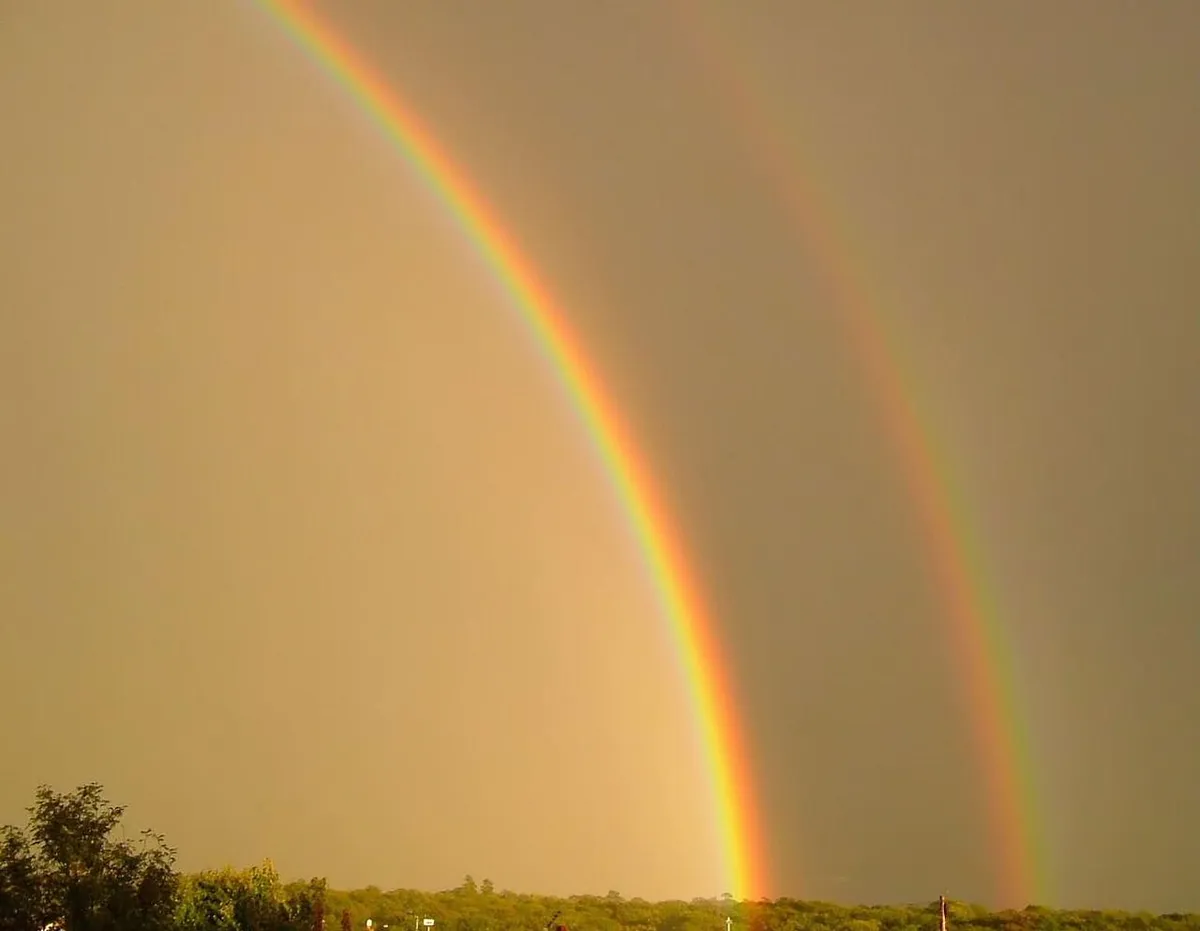
In a double rainbow, how are the colors arranged in the fainter outer secondary bow?
Light reflecting twice inside raindrops flips the color order of the outer secondary rainbow.
Question 3 of 10
Clouds float in the sky because water vapor is completely weightless.
Myth. An average cumulus cloud weighs hundreds of tons, but its microscopic droplets fall so slowly that gentle updrafts keep them aloft.
Question 4 of 10
Which wispy, high-altitude clouds are made almost entirely of ice crystals rather than liquid water droplets?
Forming above 20,000 feet where air is freezing, wispy ‘mare’s tail’ cirrus clouds consist of tiny ice crystals.
Question 5 of 10
What causes the glowing green and red curtains of the aurora borealis (Northern Lights)?
Charged solar wind particles guided by Earth’s magnetic field excite oxygen and nitrogen atoms high in the atmosphere.
Question 6 of 10
From an airplane or high mountain peak, a rainbow can actually appear as a complete full circle.
True. Ground horizons usually cut off the bottom half, but from above, the full 360-degree rainbow ring is visible.
Question 7 of 10
What causes a bright ’22-degree halo’ ring sometimes seen around the Sun or Moon?
High cirrostratus ice crystals refract sunlight or moonlight at a 22-degree angle, forming a crisp halo.
Question 8 of 10
Why do sunsets often glow vivid orange and red near the horizon?
Low-angle sunlight passes through far more atmosphere, scattering away blue light and leaving reds and oranges.
Question 9 of 10
You can walk right up to the base of a rainbow and touch where it meets the ground.
False. A rainbow is an optical phenomenon tied to the viewer’s angle relative to raindrops and the Sun—it moves as you move.
Question 10 of 10
Which rare, pouch-like clouds bulge downward beneath severe thunderstorms?
Sinking pockets of cold, moist air sculpt dramatic, smooth-lobed mammatus clouds under storm anvils.
Curious about space storms that paint polar skies? Read about a monster solar storm heading toward Earth.