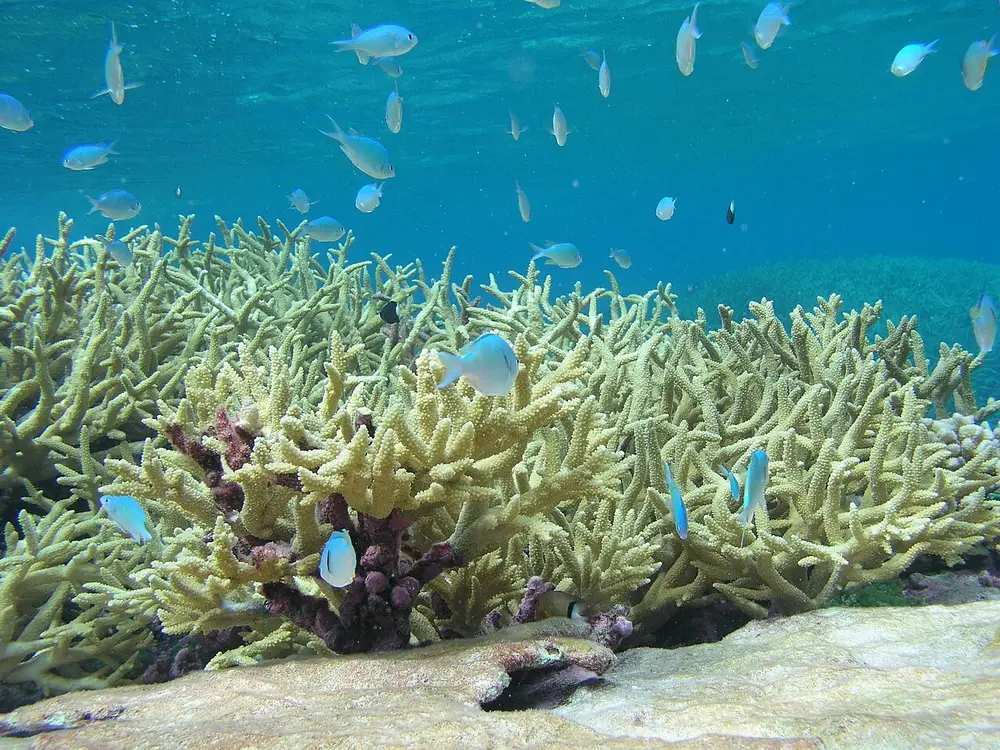
Coral reefs are among the most colorful ecosystems on the planet, yet many people misunderstand what corals actually are. Separate reef myths from science, and check out the largest ocean fish species.
Question 1 of 10
Corals are plants that grow underwater like marine shrubs.
Myth. Corals are invertebrate animals related to jellyfish and sea anemones, made up of tiny colonies of polyps.
Question 2 of 10
What gives healthy shallow-water reef corals most of their vibrant colors?
Microscopic algae called zooxanthellae live inside coral polyps, providing both vibrant pigments and up to 90% of the coral’s energy.
Question 3 of 10
Coral bleaching happens when stressed corals expel their symbiotic algae and turn white.
True. Warm water or pollution causes corals to eject zooxanthellae, revealing their pale calcium carbonate skeletons.
Question 4 of 10
Roughly what fraction of all known marine species depend on coral reefs at some stage of life?
Although reefs cover less than 1% of the ocean floor, they support roughly 25% of all marine species.
Question 5 of 10
What material forms the hard skeleton of reef-building stony corals?
Coral polyps extract calcium and carbonate ions from seawater to secrete hard calcium carbonate (aragonite) skeletons.
Question 6 of 10
A bleached coral is always immediately dead.
Myth. Bleached corals are stressed and starving, but they can recover if water temperatures cool quickly enough for algae to return.
Question 7 of 10
Which marine fish helps keep coral reefs healthy by scraping off fast-growing algae?
Parrotfish graze on algae that would otherwise smother young corals, and they excrete fine coral sand.
Question 8 of 10
All coral species live only in warm, shallow tropical waters.
False. Deep-water cold-water corals thrive in dark, chilly ocean depths thousands of meters below the surface.
Question 9 of 10
Which country is home to the largest share of the Mesoamerican Barrier Reef—including the famous Great Blue Hole?
The Mesoamerican Barrier Reef stretches over 600 miles along the coasts of Mexico, Belize, Guatemala, and Honduras, with Belize hosting its largest offshore reef and the Great Blue Hole.
Question 10 of 10
How do parrotfish protect themselves while sleeping on the reef at night?
Many parrotfish wrap themselves in a transparent mucus bubble that masks their scent from nocturnal predators like moray eels.
Interested in coastal wonders? Explore the Cliffs of Moher natural wonder in Ireland.