Earth’s icy poles regulate global climate and hold most of the planet’s fresh water. Separate polar myths from science, and read how melting ice is even shifting Earth’s rotation.
Question 1 of 10
Polar bears and penguins hunt each other in the wild.
Myth. Polar bears live in the Arctic (north), while penguins live almost exclusively in the Southern Hemisphere—they never meet in nature.
Question 2 of 10
Why does thick, ancient glacier ice often appear vivid blue?
Compressed glacier ice squeezes out air bubbles, allowing red light to be absorbed while blue light passes through and scatters.
Question 3 of 10
Roughly what fraction of an iceberg floats hidden beneath the ocean surface?
Because freshwater glacial ice is roughly 90% as dense as seawater, nearly nine-tenths of an iceberg sits underwater.
Question 4 of 10
Roughly 70% of Earth’s fresh water is stored in glaciers and ice sheets, mostly in Antarctica.
True. Antarctica’s ice sheet alone holds about 60% of the world’s fresh water, with Greenland and mountain glaciers making up the rest.
Question 5 of 10
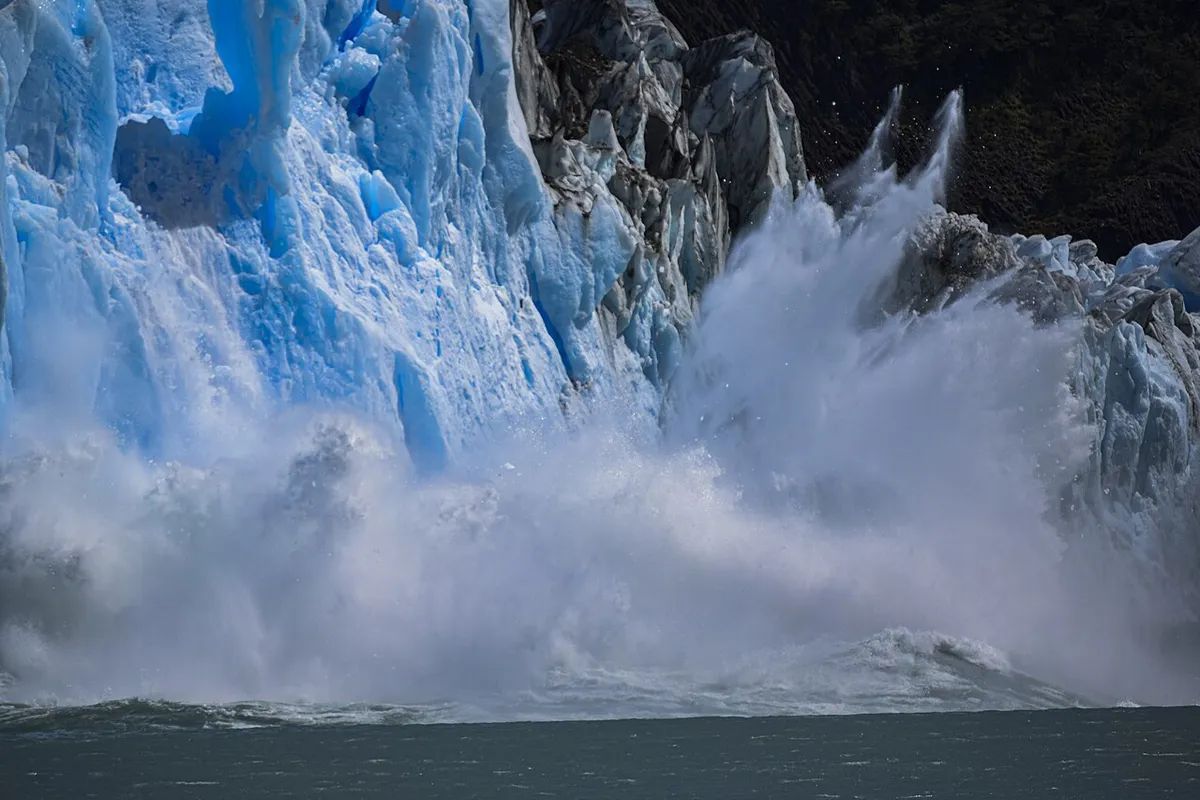
What is the scientific term for a large chunk of ice breaking off the edge of a glacier into water?
Glacier calving produces floating icebergs when fractures at a glacier’s terminus give way.
Question 6 of 10
Icebergs are made of salty frozen seawater.
Myth. Icebergs break off land-based glaciers formed from compacted snow, so they consist of fresh water.
Question 7 of 10
Which continent experiences six months of continuous daylight followed by six months of darkness at its pole?
At 90° South latitude on the Antarctic plateau, the Sun rises and sets roughly once a year due to Earth’s 23.5° axial tilt.
Question 8 of 10
Why does melting sea ice not raise global sea levels directly, unlike melting land glaciers?
Just like an ice cube melting in a glass, floating sea ice already displaces its mass—whereas land ice adds new water to the sea.
Question 9 of 10
The Arctic is mostly a frozen ocean surrounded by land, whereas Antarctica is a continent surrounded by ocean.
True. That geographic flip explains why Antarctica reaches far colder winter temperatures than the Arctic.
Question 10 of 10
What is permanently frozen ground—soil, rock, or sediment staying below 0°C for at least two consecutive years—called?
Permafrost underlies vast areas of Alaska, Canada, and Siberia, locking away ancient organic carbon.
Want to explore chilly wildlife? Try our Bears Around the World quiz.